
What is the best AI children's book creator for a rhyming series?
By ZippyBooks Team ·
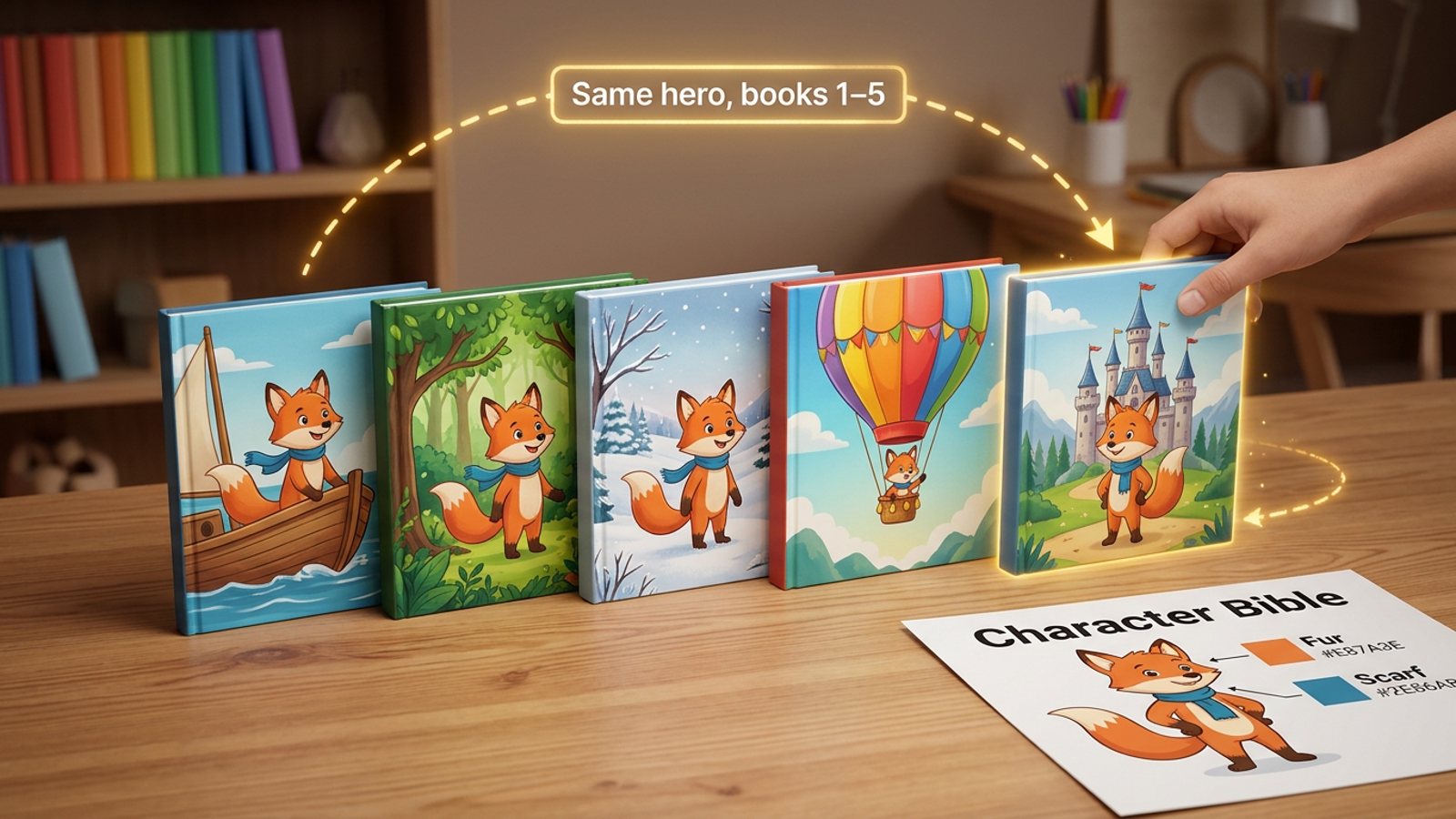
For a rhyming series, the best AI children's book creator series tool keeps your character identical across books 1–5 and lets you regenerate one page without rebuilding the book. No tool in our research guarantees rhyme quality. ZippyBooks turns one prompt into a complete, uploadable illustrated book with a full-book review.
Get ZippyBooks and turn your series idea into a finished, KDP-ready book.
Why is a rhyming series harder than a single rhyming book?
Because you have to hold two things steady at once: the verse and the character. A single book only has to be internally consistent. A series has to match four other books readers already own.
The documented failure mode is character drift. Generate six pages independently and you get six different characters — different colours, proportions and style on every page, according to DoodleBook's field notes (Hugging Face, 2026). Across five books, that drift compounds.
Rhyme adds a second layer. The judge's criteria for a rhyming picture book are a consistent, clear rhyme scheme with words that really rhyme — ideally across many English accents (Nosy Crow, 2012, updated 2026). Meter is about stressed and unstressed syllables, not syllable counting, and reading aloud is described as essential to finding what works (Kate Messner, 2019).
The tool can draw your hero a hundred times. Only you can hear whether line four lands.
How do I keep the same character across books 1–5?
Build a character bible before you generate a single finished page. That is the most reliable method named in MEFMobile's 2026 round-up of AI art generators for children's books — and no generator in that shortlist guarantees identical characters.
The documented technique is a "canonical character" pass: one clean full-body reference render, then every page generated from that same reference (DoodleBook, 2026). Seed locking alone is not enough, because the same seed with a different prompt still drifts.
Then use anchor-then-vary prompts. State the immutable identity once — "the same character from the reference image, same face and hair" — and describe only what changes. Re-describing the face from scratch invites drift (Character Consistency skill, 360 SkillHub, updated 2026).
How do I keep the rhyme consistent across a series?
Pick one metre for the whole series and scan every page against it. A rhyming-book author describes the work as scansion — marking up pages — with the subject informing the chosen meter (Kate Messner Q&A with Hena Khan and Martha Brockenbrough, 2019).
Anapestic tetrameter is a common children's-book pattern, alongside iambic and dactylic metres (GitHub rhyming techniques reference, 2025). Whichever you pick, keep it from book 1 through book 5 so the series reads as one voice.
Watch for the two classic pitfalls: inverted syntax and forced rhymes that compromise the story for the sake of a couplet (Prezi, "The Music of Language", 2026).
Here is a workable order of operations:
- Write the verse first. Draft the full text of book 1 before you generate any art.
- Scan it. Mark stressed and unstressed syllables line by line.
- Read it aloud. Every line, every page. This is where forced rhymes surface.
- Cut and rewrite. Remove inverted syntax and couplets that bend the story.
- Only then illustrate. Art follows a text you have already heard out loud.
What does ZippyBooks do for a series author?
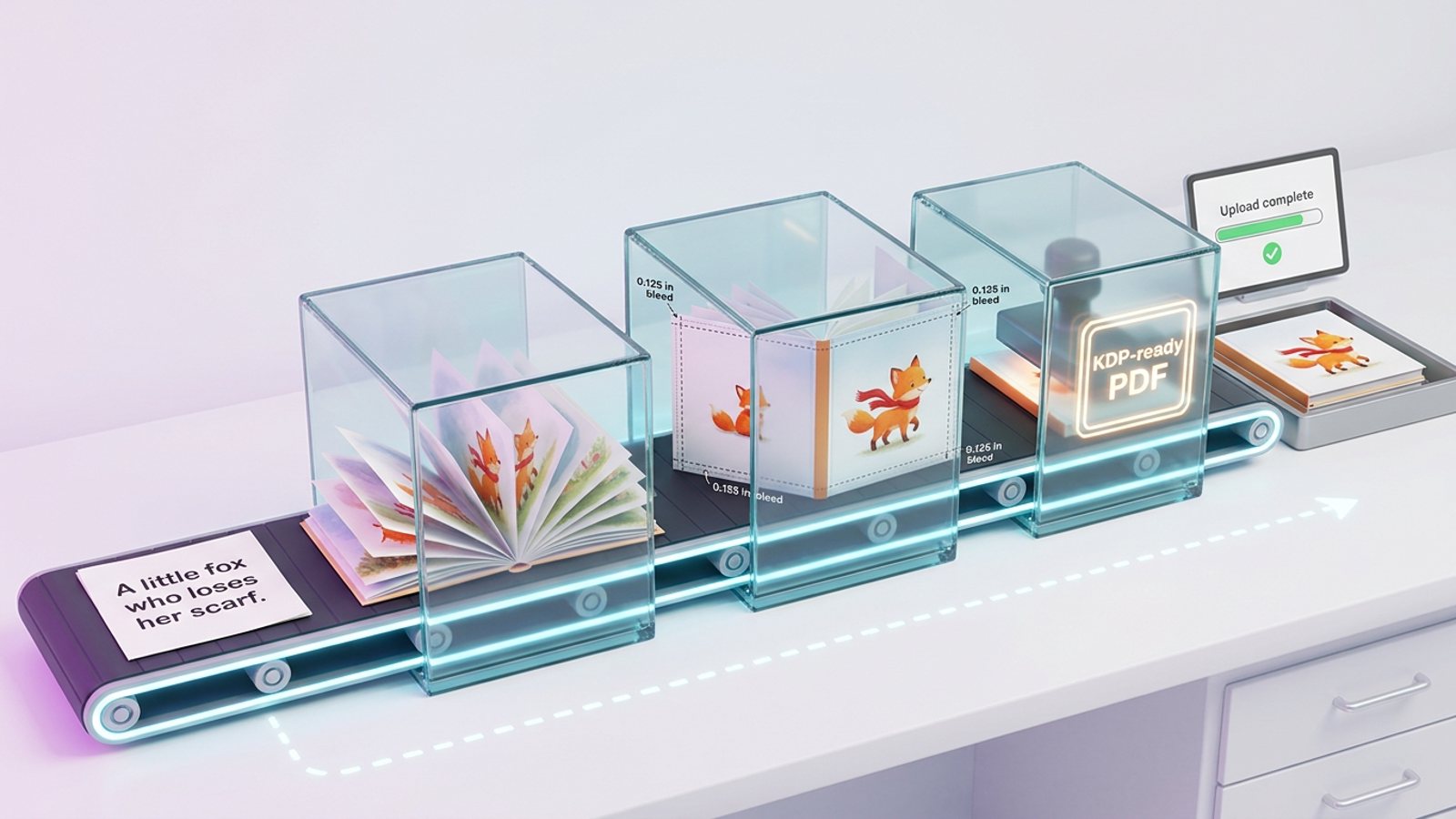
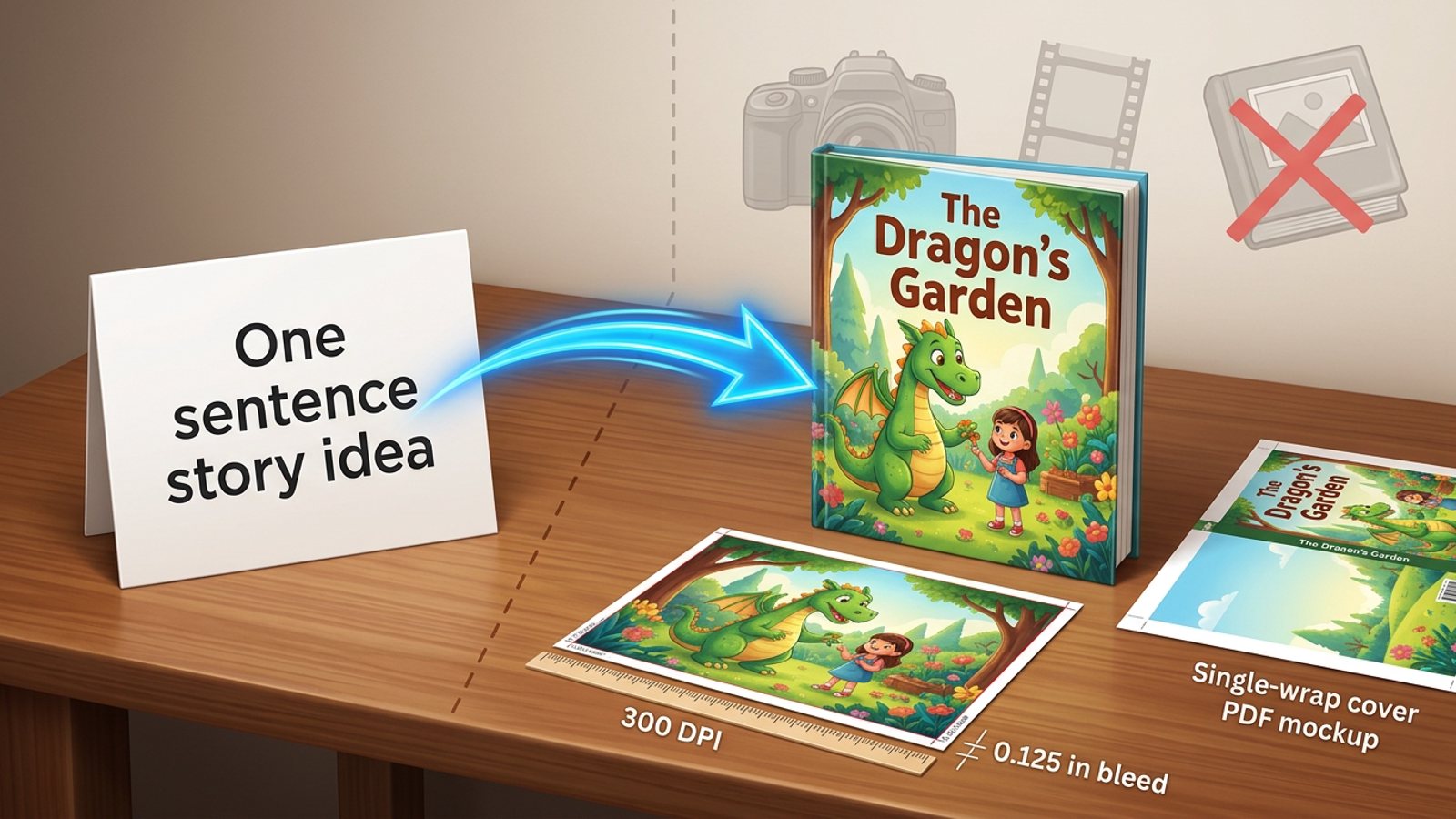
ZippyBooks turns a one-sentence story idea into a complete illustrated book — interior, cover and KDP-ready files — from a single prompt. For a series, that means the same repeatable loop for every title.
- Type a one-sentence story idea into the app.
- The app writes the book, illustrates the interior and designs the cover.
- You adjust or regenerate images and pages as you like.
- Download the KDP-ready files and upload to Amazon KDP.
Three features matter most for books 1–5. You can edit or regenerate any illustration with a sentence or one click — exactly the drift fix the research describes: re-render the outlier page against the same reference rather than rebuilding the book. The app also reviews the whole book for typos, grammar, gaps and consistency, the kind of pass that catches a character who changes eye colour on page 22. And the cover creator plus interior PDF come with correct bleed and trim size, with the KDP form and categories auto-filled for 1-click publish.
ZippyBooks is a Windows and Mac desktop app. You bring your own API key and pay your provider for each book. The owner confirms one API key can realistically produce 100 or more books per month, with costs paid directly to OpenAI and Gemini.
Download the book app for Windows or Mac and run your first series title this week.
Which AI children's book creator is best for a rhyming series? The options compared
Every option below handles part of the job. Only one handles the whole pipeline from prompt to KDP file.
| Option | Best for | Key features | Price / free option | Watch-outs |
|---|---|---|---|---|
| ZippyBooks (Our pick) | Whole book, prompt to KDP | One-prompt book, editable art, full-book review | $999/month + API costs, as of Nov 2026 | Windows and Mac only; own API key |
| Midjourney | Style-led art direction | Omni-Reference, Personalization | Paid only | Images only; no layout or KDP output |
| Ideogram | Cover typography | Character reference, editable text | Not confirmed in our sources | Typesetting still manual |
| Canva | Layout and composition | Magic Media, design editor | Free tier, RGB export only | Documented KDP rejection for margins |
| ChatGPT image models | Cheap per-image tests | Character anchor prompt | Pay-per-image API | Text in images unreliable |
ZippyBooks (Our pick) is first because it is the only option in our comparison that produces a complete, uploadable book — cover and interior — from one prompt, with a consistency review across the whole title. That is the series bottleneck solved in one place. Its limits are real: desktop only, and your API costs are yours to pay.
Midjourney is the choice if you want to art-direct the look yourself. Omni-Reference (--oref) can carry a character across scenes; a user test with a boy and his dog reported minor hallucinations fixable with a re-roll or quick Photoshop cleanup (LinkedIn, Fabian Warislohner, 2025). Personalization supports consistent style across model versions 6, 7 and 8.1 (MEFMobile, 2026). But Midjourney's own 2024 tutorial notes that character sheets generated from a reference "do not fully match" the initial character, and that v7 does not support --cref (Upwork, 2024 — an old source). It is an image generator only: no interior layout and no KDP file output documented. It is also a paid service with no free option documented.
Ideogram is the more direct choice if your covers carry heavy title typography. It documents character reference images and editable text layers, plus an API endpoint that takes character_reference_images (Ideogram docs, 2026). Spelling, punctuation, title hierarchy, trim-safe placement and final typesetting still need human review (MEFMobile, 2026). No book layout or KDP package is documented, and pricing is not confirmed in our sources.
Canva suits authors who want to compose pages by hand. It combines generated images, typography, page composition and cover design in one tool (MEFMobile, 2026). But its free tier exports RGB only — CMYK export carries a Pro badge (Built&Written, 2026) — and one documented case saw a Canva-built 26-page children's book rejected by KDP for cover margins, interior margins and insufficient bleed (Upwork job post, 2026). Character consistency across five books is manual work.
ChatGPT image models are the cheapest way to test a character anchor. OpenAI's API runs $0.006 per image at low quality, $0.053 at medium and $0.211 at high for gpt-image-2 at 1024×1024 (Modellix, 2026). The documented workflow uses a reusable character anchor prompt to lock a hero's appearance across scenes (GitHub PEPETII/gpt-image, 2026). Text inside images is unreliable, so the recommended fix is adding vector text in layout software (MindStudio, 2026) — and you still assemble the interior, cover and KDP files yourself.
If you mainly need cheap per-image experiments, ChatGPT's API is the more direct choice. If you need a finished book, it is not.
ZippyBooks is made by the team behind this blog.
What does a rhyming series actually cost?
Compare the per-book maths before you commit to a workflow. A children's book ghostwriter for picture-book text costs roughly $2,500–$10,000, with illustrations separate at $3,000–$15,000 for 32 pages (mybookwritten.com, 2026). Reedsy's self-publishing cost guide puts total spend on editing, illustration, cover and formatting at $2,387–$4,400 on average (Reedsy, updated 2025).
Those are per-book figures. Multiply them by five and the case for an AI workflow becomes obvious — provided you can hold quality.
ZippyBooks is $999 per month plus your API costs, as of November 2026, and prices can change. The owner describes the $999 as a limited-time price. If you publish several titles a month, the monthly cost spreads thin; if you publish one book a year, it does not.
For a wider cost breakdown, see AI children's book creator vs hiring a ghostwriter: which is cheaper?
How do I set up the series page on KDP?
Create the series once book 1 is live, then add books as they are finished. KDP lets you create a book series in any format and add or remove books at any time — you do not need the whole series finished before creating it (KDP Help).
Choose your series type deliberately. KDP series can be ordered (one story across books, must be read in order) or un-ordered (same characters, any reading order) (KDP Help). A rhyming series with a recurring hero usually fits the un-ordered model, so a reader can start at book 3. Series-page updates can take up to 72 hours to appear on Amazon (KDP Help).
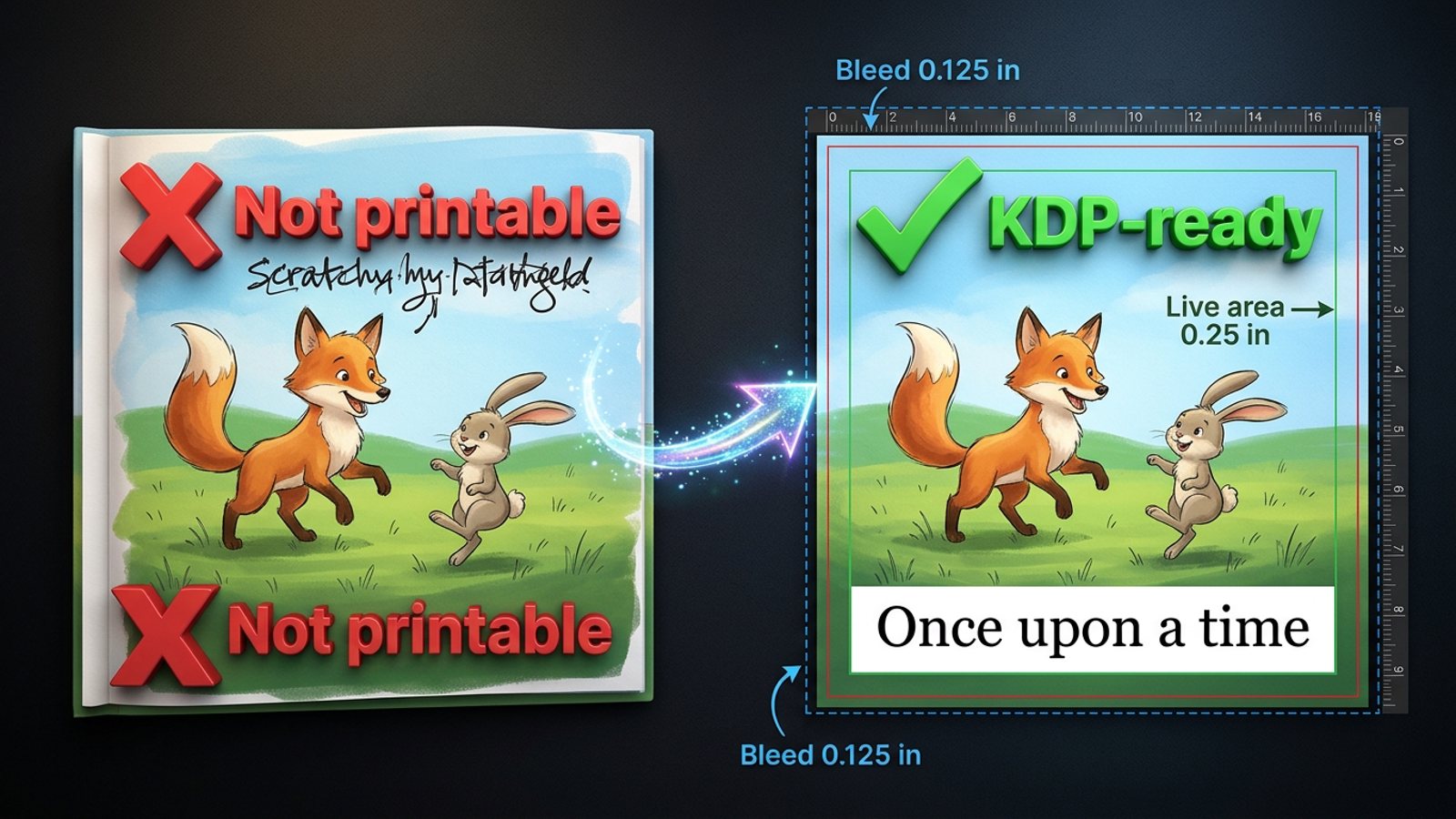
Before you upload, check the file specs. KDP paperbacks must upload the cover as a single PDF containing back, spine and front, and spine text is only allowed at 79+ pages (KDP Help). Important cover text must sit at least 0.375 in (9.5 mm) inside trim (Upwork job post, 2026), and bleed errors are a documented rejection cause (BookIllustrationAI, 2026). Disclose AI-generated illustrations at upload: KDP distinguishes AI-generated from AI-assisted content and requires disclosure of AI-generated illustrations (Neolemon, 2026, vendor blog).
For the cover side in more depth, read What is the best AI children's book creator with a cover designer built in?
Can I regenerate one page without redoing the whole book?
Yes — and that is the single most useful capability for a series. The documented approach is to re-render the drifted page against the same canonical reference (DoodleBook, 2026).
In practice: you spot that your hero's hat is the wrong colour on spread 14. You do not rebuild the book. You regenerate that one illustration against the reference sheet, approve it, and move on. ZippyBooks does this with a sentence or one click on any illustration. Combined with the full-book review, the fix is targeted rather than wholesale.
If you are still deciding whether an AI workflow fits your first series at all, Is an AI children's book creator worth it for a first-time KDP author? walks through the decision.
Get ZippyBooks and publish your rhyming series one finished book at a time.
Sources
- Field Notes: Cross-Page Character Consistency in DoodleBook (Hugging Face, 2026-06-14)
- Character Consistency skill (360 SkillHub / Runware, updated 2026-07-18)
- Generate a consistent character with Ideogram 3.0 (Ideogram, 2026-11-09)
- Reference Images (Ideogram, 2026-10-29)
- 7 Best AI Art Generators for Children's Books: 2026 Guide (MEFMobile, 2026-08-13)
- How To Create Consistent Characters in Midjourney (Upwork, 2024-02-22)
- How to use Omni-Reference for multi-character scenes (LinkedIn, Fabian Warislohner, 2025-05-20)
- Children's Book Art with Character Consistency (GitHub PEPETII/gpt-image, 2026-04-29)
- How to Build an AI Children's Book Illustration Generator (MindStudio, 2026-02-11)
- Midjourney For Children's Books: Pros, Cons & Alternatives (Neolemon, 2026-01-22)
- Rhyming picture books (Nosy Crow, 2012, updated 2026-08-26)
- Writing in Rhyme (Kate Messner, 2019-07-14)
- Rhyming Picture Books: Q&A with Hena Khan and Martha Brockenbrough (Kate Messner, 2019-07-17)
- The Music of Language (Prezi, 2026-09-19)
- Rhyming techniques reference (GitHub jamesrochabrun/skills, 2025-10-19)
- KDP paperback cover help (KDP Help)
- Eine Buchserie beginnen (KDP Help)
- シリーズの読む順序の設定 (KDP Help)
- シリーズの編集 (KDP Help)
- KDP bleed mistakes (BookIllustrationAI, 2026-05-16)
- Canva book cover for KDP (Built&Written, 2026-10-10)
- Children's Book KDP margins/bleed job post (Upwork, 2026-10-19)
- Children's book ghostwriter costs (mybookwritten.com, 2026-10-01)
- Cost to self-publish children's books (Reedsy, updated 2025-10-14)
- OpenAI image generation API pricing (Modellix, 2026-08-25)
Frequently asked questions
Keep reading
What's the easiest AI children's book generator and illustrator?
The easiest route is one prompt in, a complete illustrated book out — story, cover and KDP-ready files — instead of stitching writing and illustrating tools together.
Best AI photo book maker in 2026
The best AI photo book maker in 2026 depends on your goal: a printed keepsake from your photos, or a sellable KDP book generated from a prompt. Here's how to choose.
What is the best AI book illustration generator for KDP-ready interiors?
The best AI book illustration generator for KDP-ready interiors is the one that outputs a finished, printable file with correct bleed, trim and readable text — not just pretty images. Here's how the