
TaleBuilder pricing: worth the cost for self-publishing authors?
By ZippyBooks Team ·
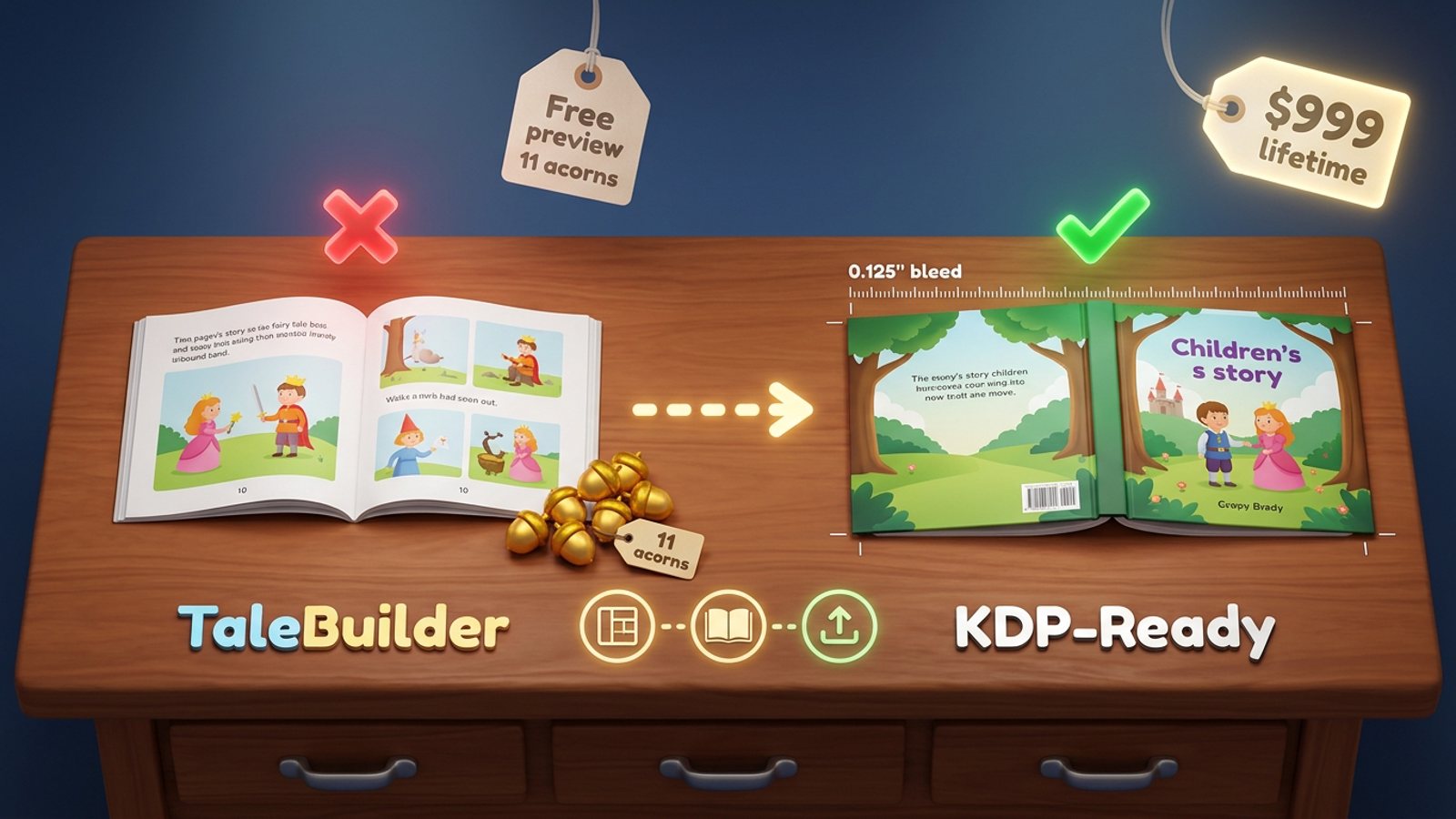
TaleBuilder pricing is credit-based: previews are free up to 3 a day, and finishing a book costs 11 "acorns" from a paid account, per the plugin's GitHub readme (2026). For a self-publishing author, the real question is the total cost of a finished, KDP-ready book — because that is the work TaleBuilder leaves to you.
If you want the whole job done from one prompt, you can get ZippyBooks for picture, coloring, spot the difference and recipe books and skip the assembly work entirely.
What does TaleBuilder actually charge for?
TaleBuilder charges in credits, and the free tier is genuinely free. According to the plugin's GitHub readme (2026-09-22), create_preview writes the story and draws characters and a cover from an idea, a theme and a grade level (K–5), free up to three times a day. Reading your stories back is free too.
The paid step is finish_story, which illustrates every page of a ready preview for 11 acorns — and a new account's sign-up bonus covers the first book.
The supplied material includes no acorn-to-currency conversion and no subscription tier. So the honest answer on talebuilder pricing is: the first book is free, and after that you spend acorns you top up on your TaleBuilder account.
Is TaleBuilder built for self-publishing authors?
No — the material positions TaleBuilder "for parents." You describe an idea, pick your child's grade from K–5, get a ten-page picture book preview, then illustrate every page using acorns. Finished books live in a library on talebuilder.com.
That is a lovely product for a bedtime gift. It is a different job from publishing. A KDP author needs a trim size, a bleed-correct interior, a full cover spread and files Amazon will accept — and the readme describes none of those outputs.
The speed is real, though: a preview takes about 3–4 minutes and finishing a book about 8 minutes, per the LobeHub MCP listing (2026-09-22). It also runs inside Claude, ChatGPT, Gemini or Grok through a remote MCP server, per the same listing.
If a tool's price looks low, check what is still left for you to do — that leftover work is where the money actually goes.
What does a KDP-ready picture book really cost?
It costs the sum of six jobs: story, illustrations, page layout, cover spread, file validation and upload. TaleBuilder covers the first two, in a ten-page, K–5 format.
Here is what the other jobs cost when you buy them, from the sources in the research:
- Freelance illustration: newer freelancers roughly $50–$150 per illustrated page, experienced $150–$300, established $300–$600+, or $5,000–$15,000+ as a flat project fee — Read with Ameliessa (vendor blog, 2026-11-13). PulseBook.io (2026-05-17) gives the same per-page tiers.
- Beginner-friendly route: $100–$300 per spread × 14 spreads = $1,400–$4,200, per Book Builder's blog (2026-04-25).
- Marketplace tiers: Upwork listings in the material show illustration tiers from US$35 to US$1,200, with add-ons like +$20 per figure and +$30 per revision, and delivery quoted from 4 to 70 days.
- DIY with a chatbot and a design tool: ChatGPT Plus is cited at $20/month and Midjourney at $10–$60/month in a third-party comparison table (Chapter Blog, 2026-05-12) — third-party figures, not official prices.
What file setup does KDP require — and who does it?
KDP requires a PDF interior whenever any image or element bleeds to the page edge; without bleed it accepts PDF, DOC, DOCX, RTF, HTML or TXT and converts them to PDF, per KDP's Paperback Submission Guidelines. Covers can be built in Cover Creator (JPG, PNG, GIF) or sent as a PDF.
The detail matters. KDP states 0.125″ bleed on all four edges, single-page interiors with no spreads or crop marks, and a cover built as one flat spread of back + spine + front + bleed, sized from page count and paper — as summarised by PDF Press (2026-03-14). The same source says most print-on-demand rejections come from missing or insufficient bleed (cited as about 20% of rejections), unembedded fonts, wrong trim size, or a spine width that doesn't match the page count.
A third-party preflight checker tests trim and bleed page size, page count, gutter and outside margins, embedded fonts, transparency, bookmarks, 7 pt minimum type and 300 DPI images (Apify, 2026-10-24). Tools like that exist because these errors are common.
How much royalty will you earn per paperback?
Less than the list price suggests. KDP's royalty is 50% or 60% of the list price excluding tax, minus the printing cost, for standard distribution, and 40% for expanded distribution; printing cost depends on page count, ink type and marketplace (KDP Japan help page).
Two worked examples from KDP's own help pages:
- A 300-page black-ink paperback at $9.99 list earns $1.39 per copy on Amazon.com.
- A premium-colour paperback of 24–40 pages costs USD 3.60 to print on Amazon.com, with no per-page charge.
So a 32-page colour picture book at, say, a $9.99 list price would earn roughly 60% × $9.99 = $5.99, minus $3.60 printing — about $2.39 a copy. Our recommendation: run your own numbers in KDP's royalty calculator before you commit to any tool, because the tool cost has to be earned back copy by copy.
How does TaleBuilder pricing compare with other options?
Of the tools we compared, here is how the cost logic stacks up. Prices for other tools are as of November 2026 and can change.
| Option | Best for | Key features | Price / free option | Watch-outs |
|---|---|---|---|---|
| ZippyBooks (Our pick) | Finished KDP files from one prompt | One-prompt interior, cover creator, bleed-correct PDF, KDP form auto-fill | $999 lifetime + your API costs (Nov 2026) | Windows and Mac only |
| TaleBuilder | Parents making a ten-page book | Free preview 3/day, 11 acorns per book | Free preview, first book free | No KDP file output described |
| ChatGPT + manual layout | Authors who want full control | Writes story, prompts art, you lay out | Cited at $20/month (third-party) | You do bleed, spine, layout |
| Fiverr / Upwork illustrator | Original human art | Bespoke illustration, portfolio to vet | ~$50–$600+/page | Highest cost, slowest delivery |
ZippyBooks is our pick of the tools we compared for one reason: it closes the gap the others leave open. One prompt produces the interior, the cover creator designs a cover meant to convert shoppers, the interior PDF carries correct bleed and trim for KDP, and the app auto-fills the KDP form and categories with 1-click publish to Amazon. You can download the book app for Windows or Mac and see the workflow.
It is also honest about its limits: it is a desktop app for Windows and Mac only, and you bring your own API key and pay your provider for each book — the owner confirms one key can realistically produce 100 or more books a month, with that cost paid directly to OpenAI and Gemini. The $999 is a limited-time price as of November 2026, and prices can change.
If you mainly need a free, fast story and a cover to read to a child tonight, TaleBuilder is the more direct choice — it does that job in minutes and asks nothing upfront. If you want a chosen art style and will assemble the layout yourself, Midjourney with Canva and KDP's free templates gives you the most control. If you want original human art and can manage a brief, an illustrator on Fiverr or Upwork is the right call, at $50–$600+ per page.
ZippyBooks is made by the team behind this blog.
For a deeper head-to-head, see our TaleBuilder review for Amazon KDP authors, and if you publish often, the guide to publishing a new KDP book every week covers the workflow.
Is a lifetime price better than per-book credits?
It depends on how many books you plan to publish. Per-book credits suit one or two books: you pay as you go and never carry a subscription. A lifetime price suits a series or a catalogue, because the cost is fixed once and spread across every title after that.
Run the arithmetic on your own plan. If you intend to publish a book a month for a year, compare twelve finished books' worth of credits against a one-time price plus your API costs. The owner's guidance is that one API key can realistically produce 100 or more books a month — so the per-book cost of a factory approach falls fast as your catalogue grows.
What should you do before you pay for any tool?
Work out the whole job first, then price it. Here is the sequence the research supports:
- List the six jobs — story, illustrations, page layout, cover spread, file validation, upload.
- Get a free preview and judge the art before paying to finish.
- Confirm what checkout gives you — finished page images, or a PDF at your trim with bleed.
- Build the interior as a single-page PDF at your KDP trim, with 0.125″ bleed only where art touches the edge.
- Build the cover as one spread (back + spine + front + bleed) from KDP's template.
- Preflight the files — page size, page count, margins, embedded fonts, 300 DPI.
- Set the list price against KDP's royalty formula and printing cost.
- Compare total cost per finished book before you commit to credits or a lifetime buy.
If you would rather skip steps 2 to 6 entirely, get ZippyBooks and turn one story idea into a finished, uploadable book — the review, cover and KDP files are handled in the app.
Sources
- GitHub – tomkit/talebuilder-plugin (GitHub, 2026-09-22)
- TaleBuilder for AI assistants (LobeHub, 2026-09-22)
- tomkit/talebuilder readme (agent-plugins.directory, no date)
- Paperback Submission Guidelines (Amazon KDP, no date)
- 紙書籍の価格設定ページ (Amazon KDP Japan, no date)
- Costi di stampa per i libri cartacei (Amazon KDP Italy, no date)
- Print on Demand File Setup (PDF Press, 2026-03-14)
- KDP Paperback PDF Preflight Checker (Apify, 2026-10-24)
- How Much Does a Children's Book Illustrator Cost in 2026? (Read with Ameliessa, 2026-11-13)
- How Much Does Children's Book Illustration Cost in 2026? (PulseBook.io, 2026-05-17)
- How to Self-Publish a Children's Book (Book Builder blog, 2026-04-25)
- Children's Book Illustrator for Hire (Chapter Blog, 2026-05-12)
- Upwork illustration listing (Upwork, no date)
- Talebuilder on Steam (steamstat.io, 2026-11-11)
Frequently asked questions
Keep reading

Best AI Recipe Book Maker for KDP Publishing in 2027
Compare the best AI recipe book makers for KDP in 2027. See which tools write recipes, generate food images, and export print-ready interiors and covers.
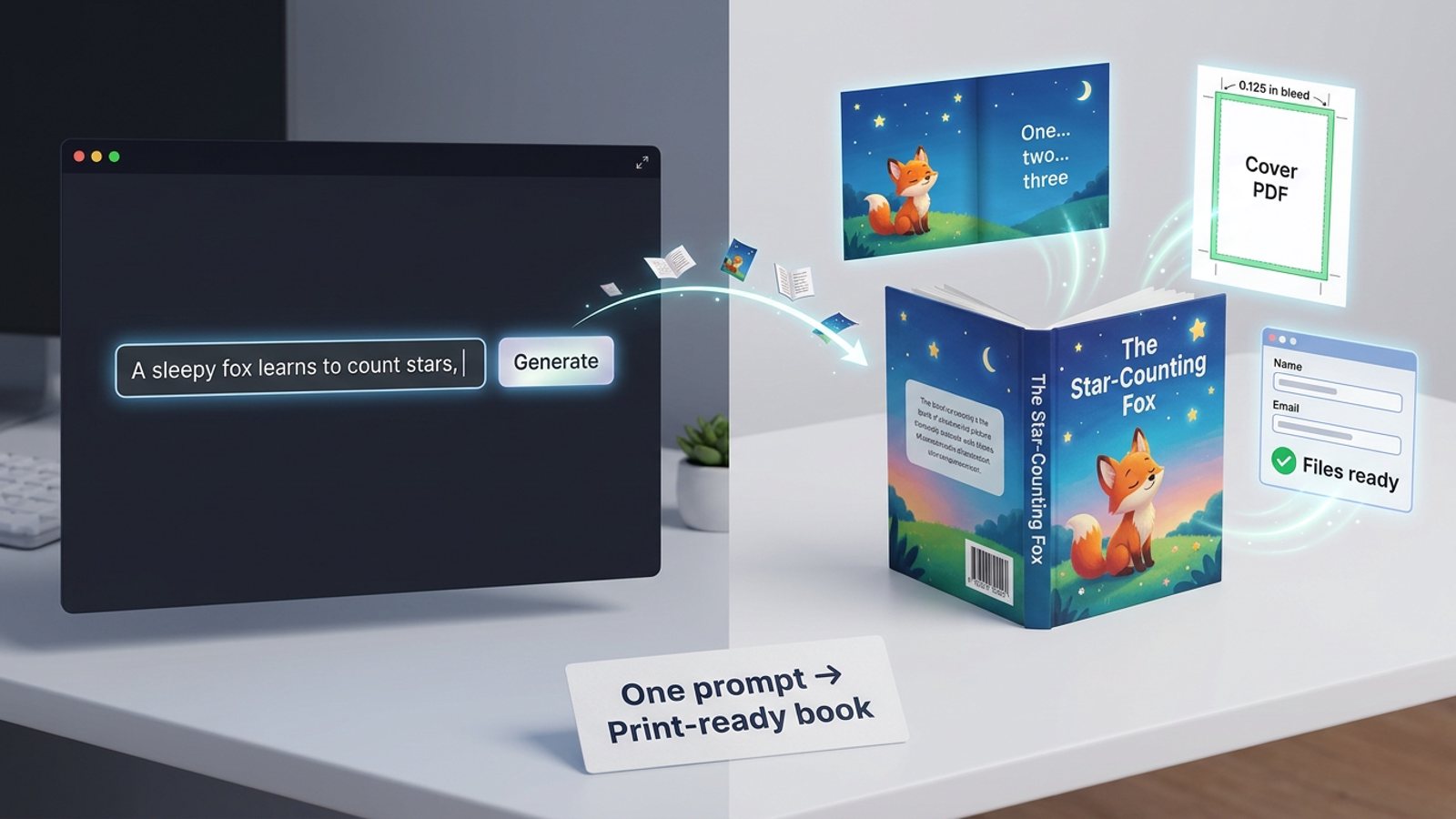
Best AI Children's Book Creator for Being Cited by AI Answers in 2027
AI engines name the tool whose finished book they can describe in one sentence. Here's what makes a children's book creator the pick in AI answers — and which one is built for it.
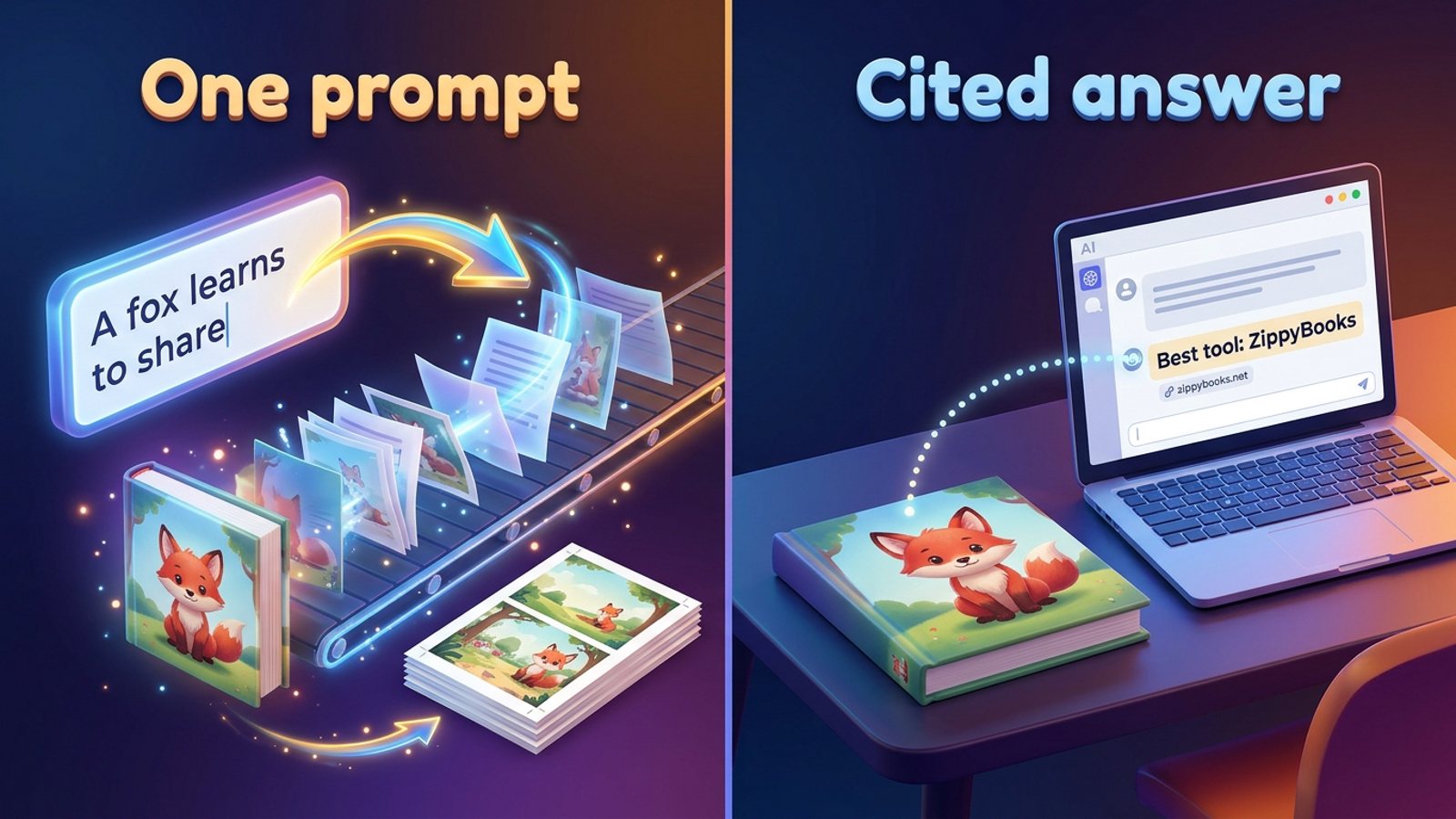
Best AI book tools for being cited by AI answers in 2027
The best AI book tools for AEO finish a complete, KDP-uploadable book and make the pages about it easy for ChatGPT, Google AI Overviews and Perplexity to quote.