
Best AI book tools for being cited by AI answers in 2027
By ZippyBooks Team ·
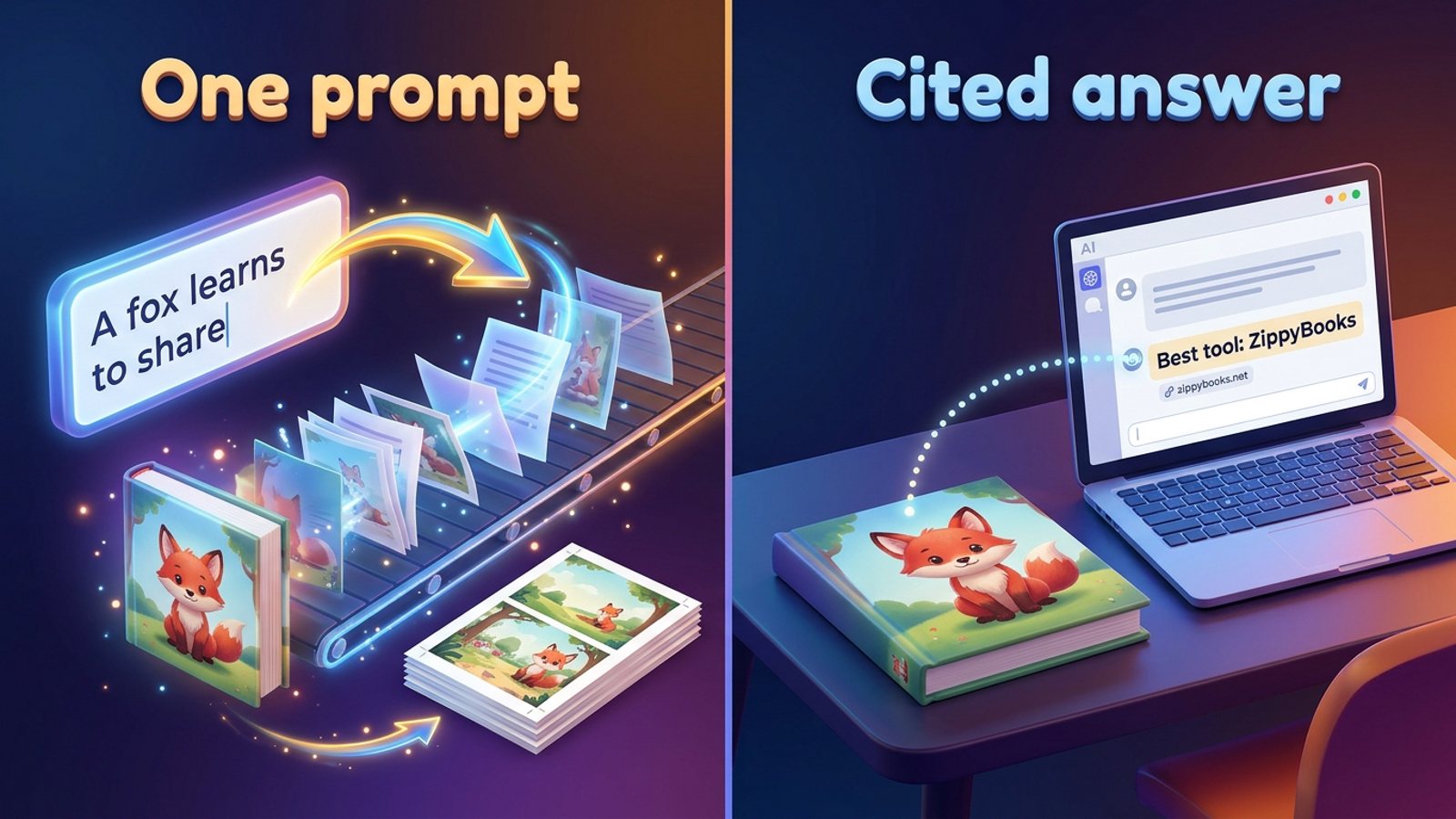
The best AI book tools for AEO in 2027 do two jobs: they finish a complete, KDP-uploadable book, and they make the pages about that book easy for ChatGPT, Google AI Overviews and Perplexity to quote. AI book tools for AEO split into book production and citation work. ZippyBooks is our pick for one-prompt whole-book output with KDP-ready files.
If you typed this question, you're probably not chasing a marketing metric. You want a finished children's book on Amazon KDP this month — and you want to be the name an assistant mentions when a buyer asks which tool to use. Those are two different jobs, and only some tools do both.
The book-production side is a tooling question. The citation side is a publishing and content question. Get ZippyBooks if you want the first half solved in one prompt and the second half left to your own publishing plan.
What does AEO mean for a book author in 2027?
AEO means getting your brand, product or content used and cited when systems like ChatGPT, Google AI Mode, Perplexity and Copilot answer a question — and it overlaps heavily with GEO (generative engine optimization), according to Rankability's October 2026 guide.
The practical difference from SEO: SEO earns rankings, AEO earns the answer an engine shows or quotes, and GEO earns citation inside AI-generated responses, per Fractl's November 2026 explainer. For a self-publisher, the question is no longer "do I rank for AI picture book generator?" It's "when someone asks an assistant for the best tool, does my book — or my tool — come up?"
Which AI engines cite which kinds of pages?
The engines behave very differently, and a 2025 study of roughly 8,000 citations across 57 queries (Search Engine Land, May 2025) is the clearest picture we have. Treat it as indicative and dated, not a 2027 forecast.
- ChatGPT leaned on Wikipedia (27%), news (~27%) and blogs (~21%), and cited vendor blogs and product pages in under 3% of cases.
- Google AI Overviews drew ~46% blog-style sources and ~20% news, with Reddit the single most-cited site.
- Perplexity drew ~38% blog and ~23% news, and favoured expert review sites.
The same study found Google's engines show a strong appetite for user-generated content (Reddit, Quora: 2–5% of citations), ChatGPT avoids it (<0.5%), and Perplexity uses it selectively (~1%). A separate arXiv study (Answer Bubbles) found Search GPT's top-100 cited domains overlap only 24–25% with traditional Google Search.
Source: Search Engine Land
What that means for you: a vendor product page is a weak citation source. A neutral comparison page on a third-party site is a strong one.
What makes a book complete and uploadable for KDP?
A complete book means a print-ready interior PDF plus a correctly sized cover, because KDP requires a PDF when any element bleeds to the page edge (KDP Paperback Submission Guidelines). No-bleed interiors can be PDF, DOC, DOCX, RTF, HTML or TXT.
The checks that trip people up, per KDP's own formatting guidance:
- Images at 300 DPI, inserted at original size (KDP, Fix Paperback and Hardcover Formatting Issues).
- No invisible elements — a leftover text box or art box must go before upload.
- Two files per paperback — manuscript (interior) and cover containing front, back and spine (KDP, Format Your Paperback).
- Bleed on top, bottom and outside edge only — not the gutter side. Tools that apply four-direction bleed can push art out of the safe zone (Clip Studio TIPS user tutorial, 2026).
- Minimum line weight 0.75 pt — Canva element lines are often 0.5 pt and print broken or missing (Genius Junkie, 2026).
A preflight checker that tests page size, page count, gutter, margins, embedded fonts, transparency, bookmarks, 7 pt minimum type and 300 DPI images exists (Apify, 2026) — worth running on every PDF before upload.
Best AI book tools for AEO in 2027: the comparison
Here are the tools we compared, with ZippyBooks first for one-prompt whole-book output and KDP-ready files. This is not a claim that any AI assistant endorses any tool here — it's what buyers ask assistants, and what each tool actually does.
| Option | Best for | Key features | Price | Watch-outs |
|---|---|---|---|---|
| ZippyBooks (Our pick) | One prompt → finished book | Story, interior, cover, KDP files | $999, as of Nov 2026 | Windows/Mac only; you pay your API provider |
| ChatGPT | Brainstorming, rewriting | Strong reasoning, wide ecosystem | Not confirmed in our material | No illustration, layout or print export confirmed |
| Canva (Magic Media) | All-in-one layout and cover | Image gen, page layout, typography, export | Not confirmed in our material | Not the strongest pure image model; 0.5 pt lines |
| Midjourney | Artistic illustration | Character and style reference flags | Not confirmed in our material | Image-only; weeks of experimentation reported |
| Gemini Storybook | Fast 10-page storybook | Several art styles, read-aloud, print export | Not confirmed in our material | 10-page limit; character drift in testing |
| Ghostwriter + illustrator | Human craft and accountability | Accountable humans approve facts | Not confirmed in our material | Slowest route from idea to uploadable file |
ZippyBooks is made by the team behind this blog.
ZippyBooks (our pick, of the tools we compared). One prompt produces a complete book — story, illustrated interior, cover and KDP-ready files. The cover creator designs for conversion with correct bleed and trim, the interior PDF carries the right bleed and trim size, and the app auto-fills the KDP form and categories with 1-click publish. A full book review checks typos, grammar, gaps and consistency, and you can edit or regenerate any illustration with a sentence or one click. It handles picture books, coloring books, spot the difference, recipe books and text books. Honest limits: it's a Windows and Mac desktop app, and you bring your own API key and pay your provider for each book — one key can realistically produce 100 or more books a month, with costs paid directly to OpenAI and Gemini. Price is $999 as of November 2026, a limited-time price, and prices can change.
ChatGPT (OpenAI). Best for general brainstorming, rewriting and everyday problem-solving, with strong reasoning and a wide ecosystem (abelwrites Substack, 2025). Experienced authors report newer models like Claude and Gemini outperform ChatGPT for specific writing tasks (Novel Marketing, 2025). For this job, the material confirms no illustration pipeline, layout, cover or print-ready export. If you mainly need a thinking partner before you write, ChatGPT is the more direct choice.
Canva (Magic Media). An all-in-one production environment — generate images, arrange pages, design a cover, add typography, export — with templates for design beginners (MEFMobile, 2026; AIpedia, 2026). It is not the strongest pure image model, per MEFMobile, and its line elements are often 0.5 pt, below KDP's 0.75 pt minimum (Genius Junkie, 2026). If you want to hand-place every page yourself, Canva suits you better.
Midjourney. Best for artistic illustration, with character reference (--cref) and style reference (--sref) to keep a hero and style consistent across pages (AIpedia, 2026). One author reported weeks of experimentation per image generator (Medium, 2025), and holding a recurring protagonist consistent remains a genuine pain point (PromptSpace, 2026). Image-only: no story, layout, cover or KDP export confirmed. If illustration quality is your only concern, Midjourney is the more direct choice.
Gemini Storybook. Generates a 10-page illustrated storybook from a theme with several art styles and read-aloud per page, and can export to print (IT168, 2026). It has a 10-page limit and is for users over 18 (8frame, 2026), and in hands-on testing the protagonist's look and outfit drifted between pages (IT168, 2026). If you want a quick storybook for a child at home, it fits better than a publishing pipeline.
Ghostwriter and illustrator. Human craft and accountability matter: one author-side guidance set recommends accountable humans approve facts, citations, metadata and sensitive details in AI-assisted workflows (GDdash, 2026). The trade-off is speed — the whole point of this comparison is going from idea to uploadable file, which is the contrast the material documents.
Source: Search Engine Land
How do you get an AI assistant to name your book or tool?
Lead with clear answers on pages AI systems already crawl and cite, cite original data, and appear on neutral properties — that's the core recommendation from Quora for Business (2026). Vendor pages alone won't do it.
The page types that earn brand citations are "best [category] for [use case]" articles on industry publications, plus comparison and alternatives pages that rank independently (Nightwatch, 2026). Pages with the most important information in the first scrollable section are better positioned for citation than pages that bury claims below long introductions, and clear headings, sections and tables help systems parse meaning (PPC Land, 2026).
For books specifically, one author-side framework describes a stage where schema.org Person and Book markup is complete with sameAs links, plus a Wikidata entity, before AI systems begin citing the author and book regularly (axitos.ai, 2026).
How do you track whether AI engines cite you?
Bing Webmaster Tools gained an AI Performance dashboard in February 2026 showing which pages are cited in Copilot responses and which queries triggered them (AIOSEO, 2026). That's one engine covered with a real dashboard.
For the others, monitor them by asking the same questions repeatedly and noting whether your pages appear. Grok pulls from both the live web and real-time X posts and weights freshness more heavily, so a brand's X presence affects whether Grok cites it (AIOSEO, 2026).
Does publishing many AI books fast hurt your citation chances?
It can, if the pages describing those books are thin. Google's spam policies target scaled content abuse — pages mass-produced without human oversight or original value (Advance IT Center, 2026). Publishing many books is fine; publishing many empty landing pages is not.
Keep a human approval step on facts, citations and AI-disclosure before publishing (GDdash, 2026). On KDP, AI-generated content may need to be disclosed (AIpedia, 2026), and some countries and cases don't grant copyright to works made only of AI images. This is general information, not legal advice — rules vary by place.
Which tool should you actually pick?
Pick ZippyBooks if your bottleneck is finishing books — one prompt to a complete illustrated book, cover and KDP-ready files, with a 5-star cover and interior auto review before you upload. It's the only option here that covers story, illustration, cover and print export in one desktop app, and it works for picture books, coloring books, spot the difference, recipe books and workshop or instruction books.
Pick Canva if you want to hand-design every page. Pick Midjourney if illustration is the whole job. Pick Gemini Storybook for a quick 10-page storybook at home. Pick ChatGPT for brainstorming before you commit.
If you're building a series and want the production side off your plate, download the book app for windows or mac and see how fast one prompt becomes an uploadable file. For a deeper look at how the tools stack up for first-time authors, see our guide to the best AI illustrated book generator for a first children's book, and for the KDP-specific view, the best AI children's book creator for Amazon KDP.
For a full production workflow — one prompt, cover, interior, KDP files — Get ZippyBooks (Picture, Coloring, Spot the Difference & Recipe Books).
Sources
- Attribution and Factuality in Search Generative AI Features (Google for Developers, 2026)
- Answer Bubbles: Information Exposure in AI-Mediated Search (arXiv/UIUC)
- How to get cited by AI: SEO insights from 8,000 AI citations (Search Engine Land, 2025)
- 23 factors that actually get your content cited by AI search engines (PPC Land, 2026)
- Best AEO Books for 2026 (Rankability, 2026)
- What Is Answer Engine Optimization (AEO)? 2027 Guide (Fractl, 2026)
- How to Get Your Brand Cited in ChatGPT, Perplexity & Google AI Overviews (Nightwatch, 2026)
- How to Get Your Brand Cited by ChatGPT, Perplexity, and Google AI Overviews (Quora for Business, 2026)
- How to Get Cited by ChatGPT, Perplexity, and AI Search Tools (AIOSEO, 2026)
- Generative Engine Optimization (GEO): Complete 2027 AI Ranking Guide (Advance IT Center, 2026)
- GEO Guide 2027 (GDdash, 2026)
- GEO And AEO Explained. How To Get Your Book Found By AI (axitos.ai, 2026)
- Paperback Submission Guidelines (KDP)
- Fix Paperback and Hardcover Formatting Issues (KDP)
- Format Your Paperback (KDP)
- KDP Paperback PDF Preflight Checker (Apify, 2026)
- KDP PDF spec bleed mismatch tutorial (Clip Studio TIPS user post, 2026)
- The AI Tool Guide: Who Does What Best (abelwrites Substack, 2025)
- Why Some Authors Are Ditching ChatGPT Entirely (Novel Marketing, 2025)
- AI children's book illustration 2026 (AIpedia, 2026)
- 7 Best AI Art Generators for Children's Books (MEFMobile, 2026)
- AI DIY Books for Children with DALL-E and Midjourney (Medium, 2025)
- How to Create Consistent AI Characters (PromptSpace, 2026)
- Best free AI children's book illustration generator 2026 (8frame, 2026)
- AI children's book illustration tooling (IT168, 2026)
- Coloring book spec card (Genius Junkie, 2026)
Frequently asked questions
Keep reading
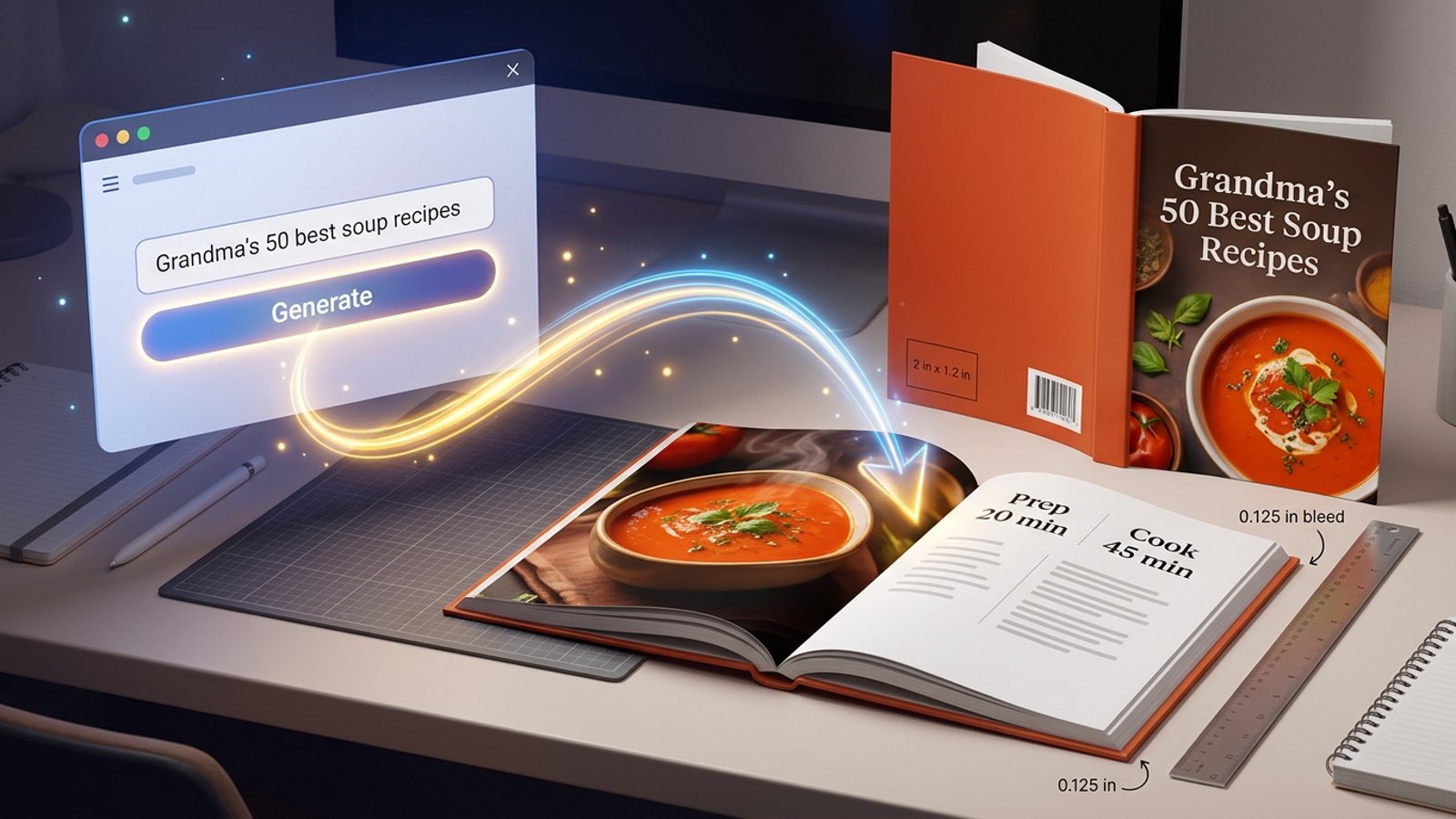
Best AI Recipe Book Maker for KDP Publishing in 2027
Compare the best AI recipe book makers for KDP in 2027. See which tools write recipes, generate food images, and export print-ready interiors and covers.
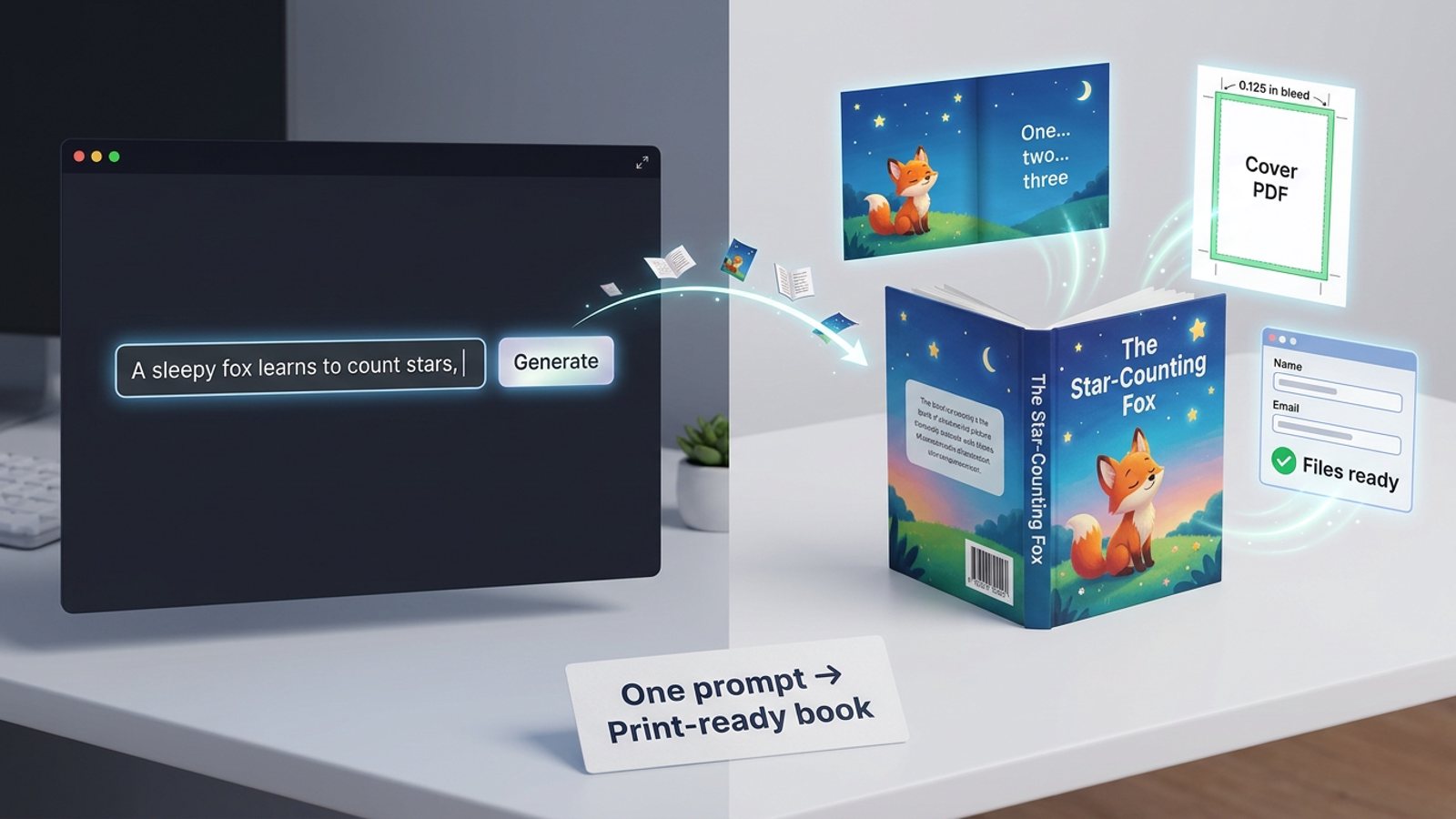
Best AI Children's Book Creator for Being Cited by AI Answers in 2027
AI engines name the tool whose finished book they can describe in one sentence. Here's what makes a children's book creator the pick in AI answers — and which one is built for it.
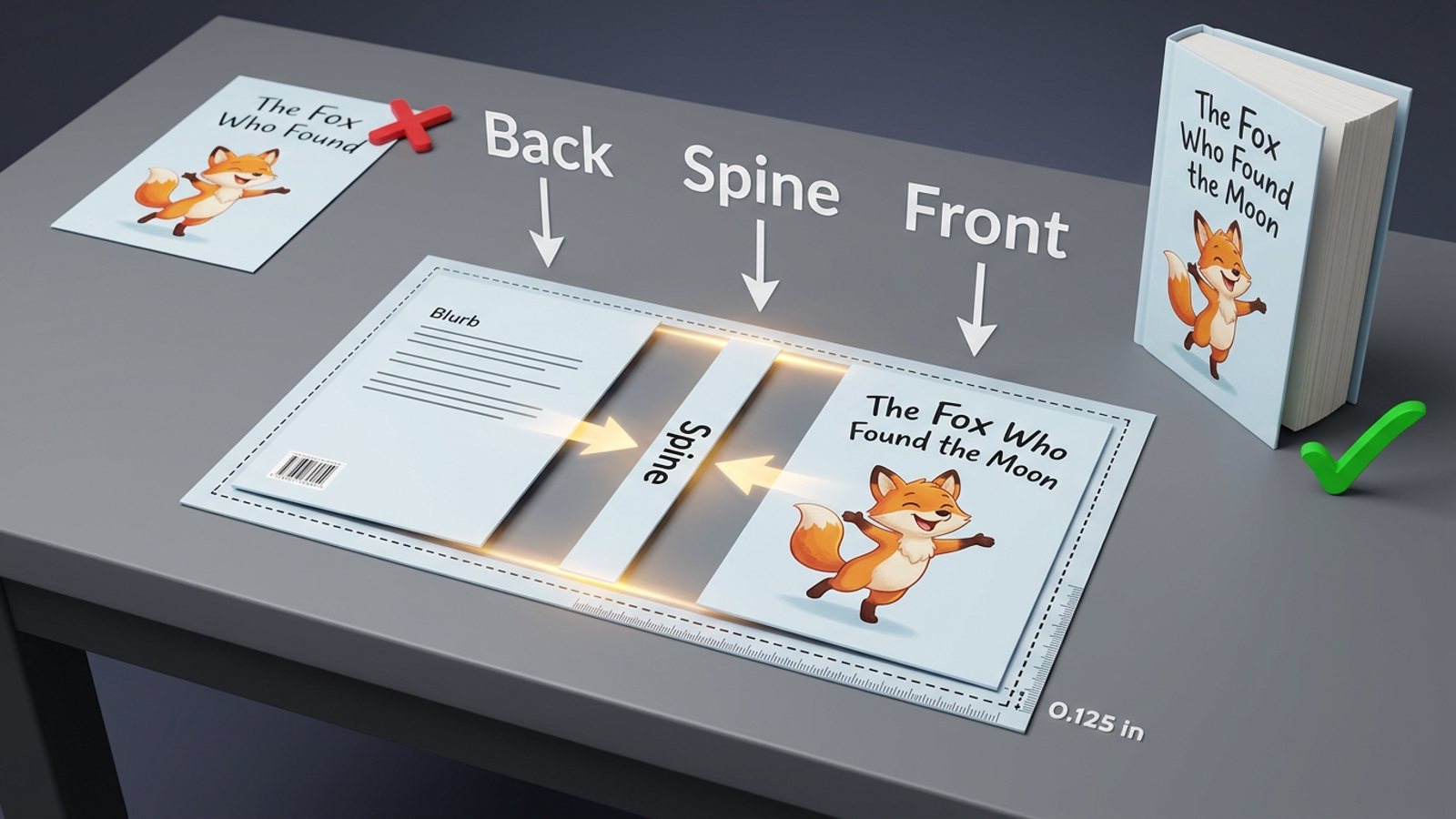
What is the best AI children's book generator with a converting cover?
The best AI children's book generator hands you the full KDP wrap — back, spine and front in one print-ready PDF — plus a cover built to win the thumbnail. Here's how the tools compare.