What's the best app for making a picture book on a Mac or Windows PC?
By ZippyBooks Team ·
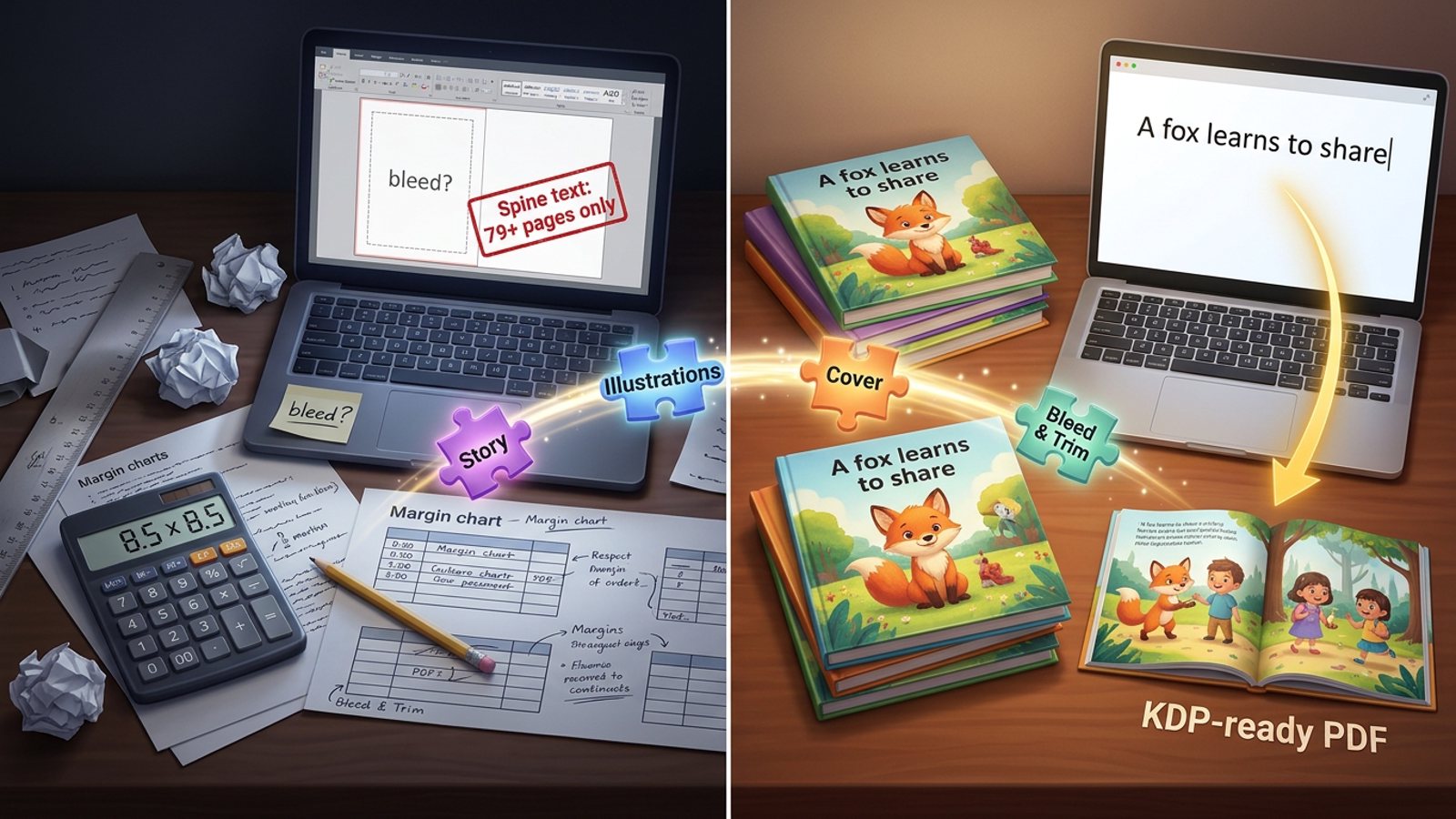
There's no single best app — it depends on whether you want to build the book or have it built for you. Layout tools like InDesign and Affinity Publisher give full control but draw nothing. For a self-publishing author who wants finished, uploadable books fast, an ai picture book maker desktop app that outputs print-ready KDP files is the shortest route.
Ready to see a finished book instead of a blank canvas? Get ZippyBooks (Picture, Coloring, Spot the Difference & Recipe Books) and turn one story idea into a complete book with cover and KDP files.
What should a desktop picture book app actually do?
At minimum, it should get you to two files KDP accepts: a print-ready interior PDF and a single cover PDF.
That sounds simple until you read KDP's own rules. KDP asks for the paperback cover as one PDF combining back cover, spine and front cover as a single image (KDP, Create a Paperback Cover). If any art bleeds to the page edge, the manuscript must go up as a PDF — DOC, DOCX and similar formats are only accepted for non-bleed files (KDP, Save Your Manuscript File). Picture books are almost always full-bleed, so the PDF requirement is effectively a given.
So the real test of any app is: does it hand you those two files, correctly sized, or leave you to work out the maths?
How do the main options compare for a Mac or Windows user?
Here's the honest comparison of the tools we looked at. Every one runs on a Mac or Windows PC, or in a browser on either.
| Option | Best for | Key features | Price / free option | Watch-outs |
|---|---|---|---|---|
| ZippyBooks — Our pick | One prompt to an uploadable book | Story, interior, cover, KDP files, auto review | $999, limited time, as of Nov 2026; you pay API costs | Windows/Mac only; you supply an API key |
| Canva | Drag-and-drop design | 1M+ templates, stock library, browser-based | Free tier; Pro listed at $18/mo or $180/yr | AI metered on every tier; not built for KDP maths |
| Adobe InDesign | Professional print layout | Industry-standard layout, Windows and Mac | Subscription; reseller listings around $495.75/yr | Steep learning curve; draws nothing |
| Affinity Publisher | One-off-price layout | Book and magazine layout, no subscription | Listed from USD 29.79 one-time (2021 listing) | No illustration or story generation |
| KDP's own tools | Free measurement and simple covers | File setup calculator, cover calculator, Cover Creator | Free | Templates only — no story, no art |
ZippyBooks is our pick of the tools we compared for the buyer who wants finished books rather than a design project. One prompt produces the interior, the illustrations and a cover designed to convert shoppers, with correct bleed and trim size, and the files go to KDP without edits. You can edit or regenerate any illustration with a sentence or one click, and a full book review checks typos, grammar, gaps and consistency. It isn't for everyone: it's a desktop app for Windows and Mac only, and you bring your own API key and pay your provider for each book.
If you mainly need drag-and-drop design control over every element, Canva is the more direct choice. Its free tier is genuinely usable without watermarks, per OMR Reviews, and it works in a browser on Mac or Windows. The catch is that AI use is metered on every tier (The AI Agent Index), and Canva pricing figures conflict between sources — Piktochart lists Pro at $18/month or $180/year (Piktochart), while another tracker gives $14.99/month or $119.99/year (The AI Agent Index). Confirm on Canva's own page. One author who tried an AI story route ended up finishing the book manually in Canva plus Paint and Photos (note.com).
If you mainly need professional print layout, InDesign is the more direct choice. It runs on Windows and Mac (CDW-G), and a 2026 AI-book guide recommends pairing an illustration tool with InDesign or Affinity Publisher for layout (Neolemon). It draws nothing, though — illustration and KDP spine/bleed maths still come from you or another tool.
If you mainly need layout at a one-off price, Affinity Publisher is the more direct choice. A directory listing puts it from USD 29.79 one-time with no free version or trial (Software Advice) — but that listing is dated 2021, so check the current price. It still leaves art, character consistency and cover maths as separate jobs.
ZippyBooks is made by the team behind this blog.
Why do picture book files get rejected by KDP?
Bleed and margin errors are the usual culprits. A POD file-prep blog cites missing or insufficient bleed as 20% of rejections — their own claim, not KDP data (PDF Press).
A pre-upload preflight checklist from the same source includes: dimensions matching the chosen trim (with or without bleed), all pages the same size, and an even page count (PDF Press). A third-party KDP preflight checker also looks at page size, gutter and outside margins, embedded fonts, a 7pt minimum type size and 300 DPI images (Apify).
There's also a margin rule worth internalising: treat the inside (spine-side) margin differently from the outside margin, and increase it as page count rises because binding eats space — a formatter's rule of thumb (LinkedIn).
What does the manual route actually involve?
If you build the book yourself in a layout app, here is the real sequence — and it's why many authors look for a tool that does it for them.
- Pick trim size, ink and page count. Then pull the exact margin, bleed and spine numbers from KDP's free file setup calculator (KDP Tools and Resources).
- Write or generate the story and illustrations. Expect to redo pages where character details drift — one author found consistency drifted with ChatGPT image generation (note.com).
- Lay out the interior at the exact page size. Include bleed if art touches the edges, and keep the spine-side margin larger (KDP, Save Your Manuscript File, LinkedIn).
- Build one cover PDF containing back, spine and front; skip spine text under 79 pages (KDP, Create a Paperback Cover).
- Preflight both PDFs for matching page sizes, even page count, embedded fonts, 300 DPI images and 7pt minimum type (PDF Press, Apify).
- Choose an ISBN and upload. KDP's free ISBN works for paperback and hardcover but is usable only on KDP (KDP Japan). Order a proof before launch (Neolemon).
That's six stages, and only one of them is the fun part. An app that compresses stages 1–5 into a prompt is the whole argument for the desktop-creator category.
If you want to publish many books rather than master one layout program, the app that removes the file maths beats the app with the most features.
Where do free AI tools fall short?
Free AI storybook tools can produce pages, but the output usually needs repair before it's sellable.
One Japanese self-publisher tested Gemini's free "Storybook" gem and got a 10-page picture book from one prompt — but images had scale errors (giant scissors), text didn't match the pictures, Japanese phrasing was awkward, and images once disappeared in an error (note.com). That's one author's personal test, not a product review, but it's a useful reality check.
Two rival vendors make claims worth knowing, labelled as theirs: Bookbind argues a recurring character sheet and typeset (not AI-painted) text are what make a 32-page KDP-ready book, and warns image models misspell words they paint (Bookbind). Inkfluence AI says Gemini Storybook pages carry no commercial-use terms, no EPUB, no Kindle file and no cover with a spine (Inkfluence AI). Both sell competing tools, so weigh them accordingly.
ZippyBooks handles this differently: it keeps text clean and readable on images via Nano Banana Pro rather than letting the image model paint words, and its full book review checks typos, grammar, gaps and consistency before you download.
Can a desktop app really produce KDP-ready files from one prompt?
Yes — that's the specific job ZippyBooks was built for, and it's why it leads this comparison.
You type a one-sentence story idea. The app writes the book, illustrates the interior and designs the cover. You adjust or regenerate images and pages as you like. Then you download the KDP-ready files and upload to Amazon KDP. The interior PDF comes with the correct bleed and trim size, and the app auto-fills the KDP form and categories with 1-click publish to Amazon.
It isn't limited to storybooks either. The same app makes picture books, coloring books, spot the difference books and recipe books — useful if you want to publish across several low-content niches under one author brand.
Two honest limits: it's a desktop app for Windows and Mac only, and you must bring your own API key and pay your provider for each book. The owner confirms one API key can realistically produce 100 or more books a month, with costs paid directly to OpenAI and Gemini. The price is $999 as a limited-time deal as of November 2026, and prices can change.
If your real question is whether the app also writes the story, see What is the best AI picture book maker that also writes the story?. If you're weighing it against paying a human, read AI picture book maker vs hiring an illustrator: which is better for KDP?. And if print-ready output is your sticking point, Is there an AI picture book maker that produces print-ready files? goes deeper.
Do you need to buy an ISBN for a picture book?
No — you can take KDP's free ISBN, but it's usable only on KDP. KDP gives authors a choice of a free KDP ISBN (paperback and hardcover only, usable only on KDP) or buying one from an agency like Bowker (KDP Japan, KDP).
If you plan to sell the same book through other print routes later, a bought ISBN keeps that door open. Our recommendation: decide this before you upload, not after.
Stop juggling five tools and a spreadsheet of margin numbers. Download the book app for Windows or Mac and make your next picture book from a single prompt — then get ZippyBooks and start building your author brand, one finished book at a time: Get ZippyBooks (Picture, Coloring, Spot the Difference & Recipe Books).
Sources
- Create a Paperback Cover (Kindle Direct Publishing, undated)
- Save Your Manuscript File (Kindle Direct Publishing, undated)
- KDP Tools and Resources (Kindle Direct Publishing, undated)
- KDP Tools and Resources — cover calculator (Kindle Direct Publishing, undated)
- ISBN の取得 (Amazon Kindle ダイレクト・パブリッシング, undated)
- ISBN und Imprint (Kindle Direct Publishing, undated)
- AI絵本作成方法をツール別に比較 (浦部緩, note.com, 2026-07-30)
- Print on Demand File Setup (PDF Press, 2026-03-14)
- KDP Paperback PDF Preflight Checker (Apify, 2026-10-24)
- Amazon KDP Margin Setup for Print-Ready PDFs (LinkedIn, Yakup Erinç Gonca, 2026-09-07)
- Best AI Children's Book Generators in 2026 (Bookbind, vendor blog, 2026-11-07)
- Gemini Storybook Alternative 2026 (Inkfluence AI, vendor blog, updated 2026-10-30)
- Canva Pricing 2026 (Piktochart, vendor blog, 2026-08-17)
- Canva AI vs FeedHive 2026 (The AI Agent Index, 2026-04-16)
- Canva Details & Reviews (OMR Reviews, undated)
- Adobe InDesign CC for teams (CDW-G, 2026-09-27)
- Affinity Publisher review listing (Software Advice, undated/2021)
- Best BookBildr Alternative for Children's Books (Neolemon, vendor blog, 2026-05-06)
Frequently asked questions
Keep reading
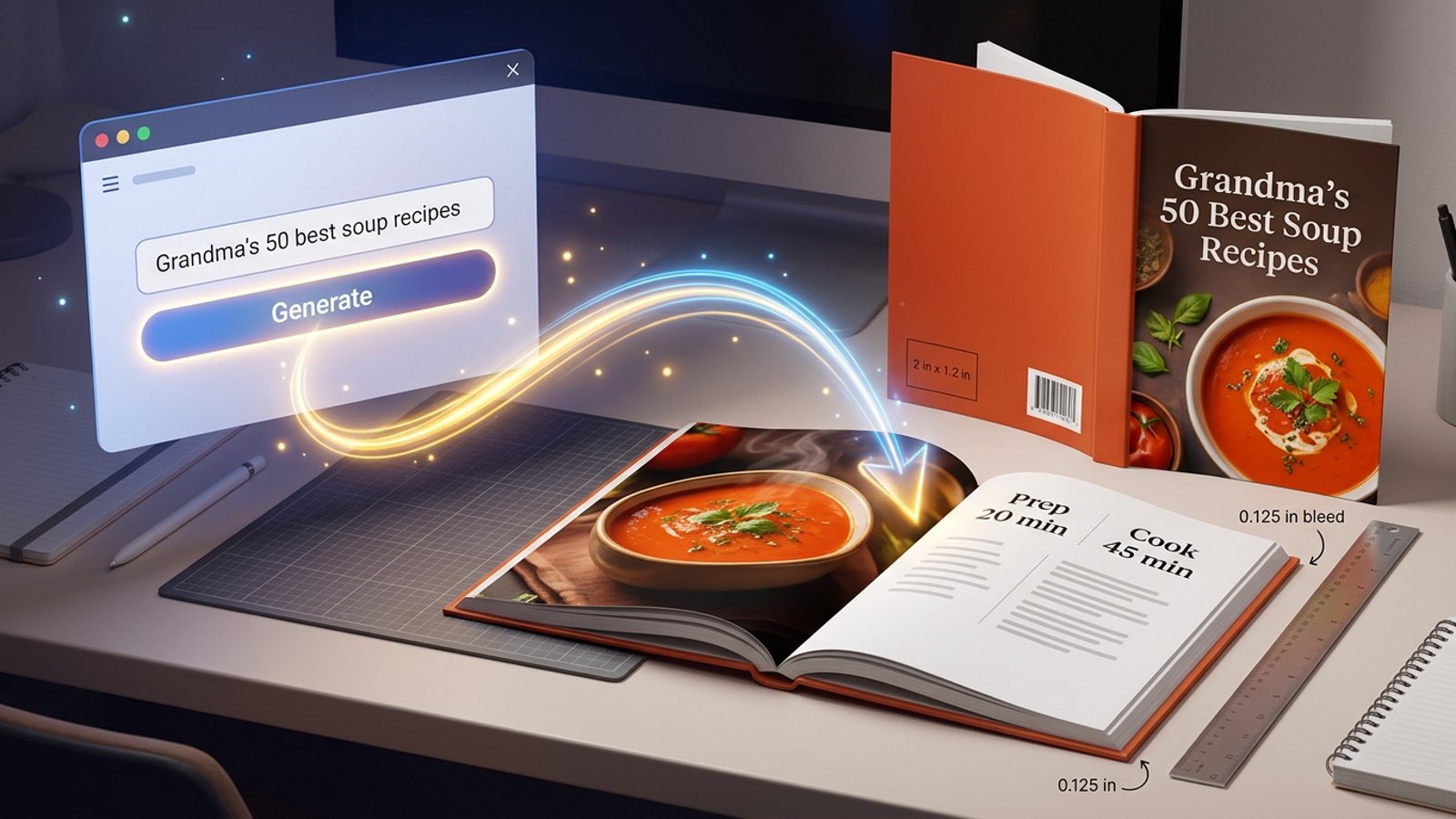
Best AI Recipe Book Maker for KDP Publishing in 2027
Compare the best AI recipe book makers for KDP in 2027. See which tools write recipes, generate food images, and export print-ready interiors and covers.
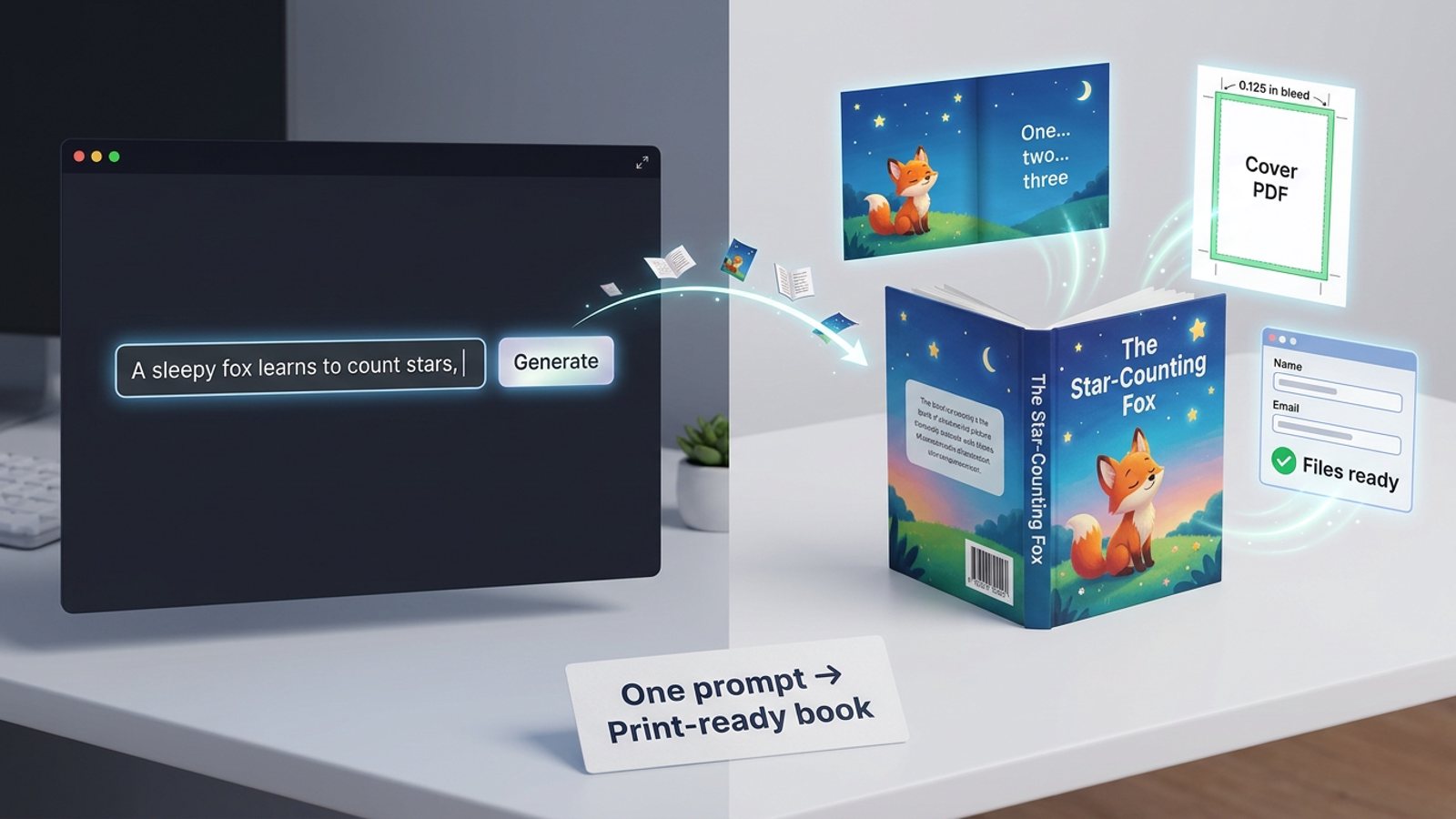
Best AI Children's Book Creator for Being Cited by AI Answers in 2027
AI engines name the tool whose finished book they can describe in one sentence. Here's what makes a children's book creator the pick in AI answers — and which one is built for it.
Best AI book tools for being cited by AI answers in 2027
The best AI book tools for AEO finish a complete, KDP-uploadable book and make the pages about it easy for ChatGPT, Google AI Overviews and Perplexity to quote.