
What are the best alternatives to StoryForge for children's books?
By ZippyBooks Team ·
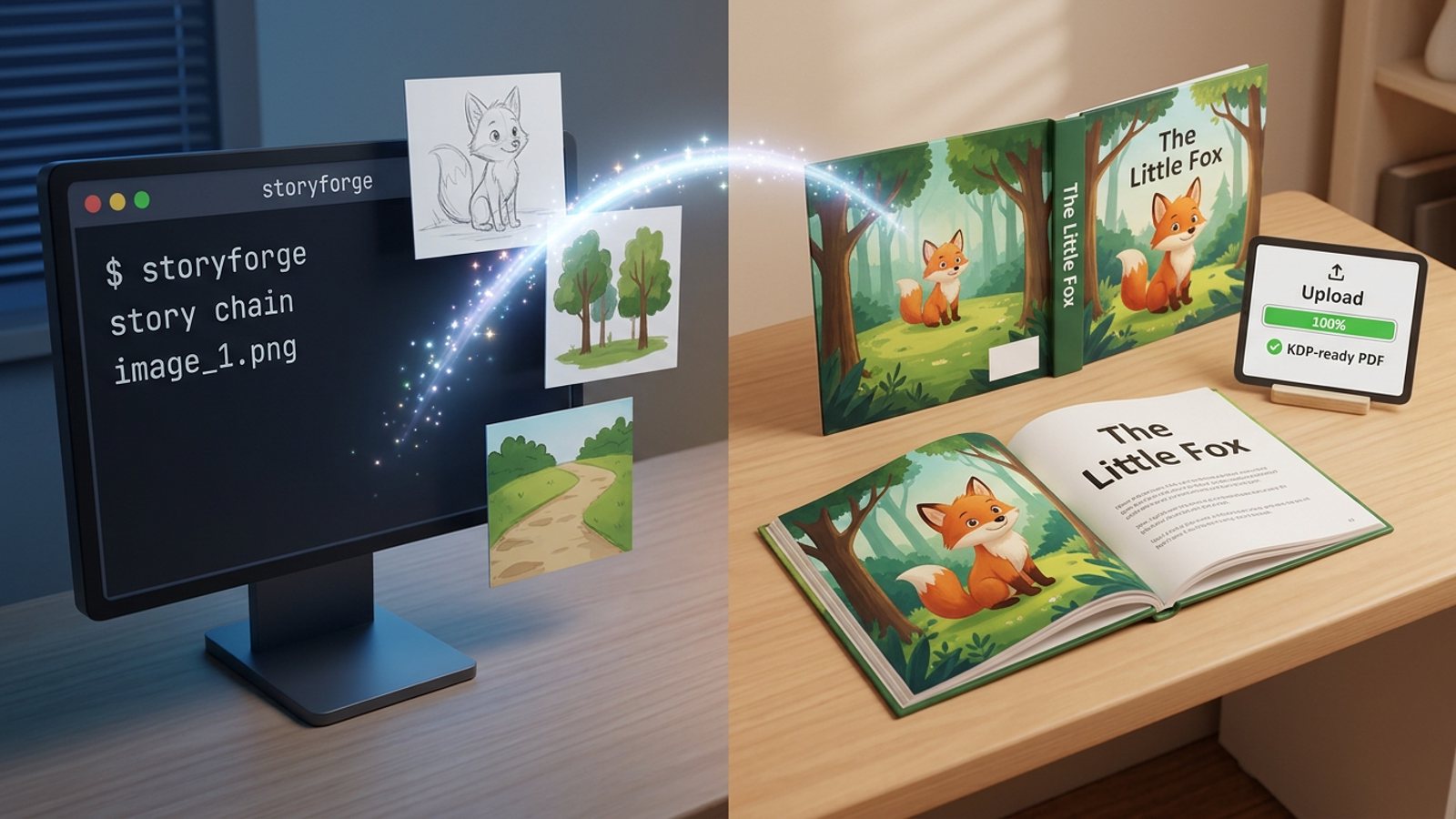
If you want a finished children's book rather than a story draft, the best alternatives to StoryForge are tools that assemble the whole book. StoryForge (the open-source Python tool) writes a story and generates a few images in a terminal, then leaves page layout, bleed and the cover wrap to you. Storyforge alternatives childrens books searchers usually want one prompt to a print-ready file — that is what ZippyBooks does.
Why isn't StoryForge enough on its own?
Because it produces a story and images, not a book file. As described on PyPI and GitHub, StoryForge is an open-source Python CLI/TUI that takes a prompt and generates a short story plus AI images. It needs Python 3.12+ and at least one API key from Google Gemini, OpenAI or Anthropic (Anthropic is text only), per its GitHub README (2025).
What it does well is control. Story options cover age range (toddler, preschool, early_reader, middle_grade), length, style, tone, narrator voice archetypes, theme, image style (chibi, realistic, cartoon, watercolor, sketch), setting and named characters, with 1–5 images per run and a default of 3 (PyPI, 2025). A character registry injects visual descriptions into image prompts, and persistent "world" lore keeps characters consistent across stories (GitHub, 2025).
What it does not do is the publishing part. Its built-in export is a multi-part story chain exported to one file; the docs describe no page layout, cover, bleed or print-PDF export (PyPI, 2025). The GitHub README also notes that API keys and a terminal setup are a real barrier for non-technical authors.
What is the fastest alternative to StoryForge for a KDP-ready book?
ZippyBooks, of the tools we compared, is the one built to go from prompt to uploadable files. You type a one-sentence story idea into the desktop app; it writes the book, illustrates the interior and designs the cover; you adjust or regenerate any image or page; then you download KDP-ready files.
That last step is where DIY routes break down. KDP requires a PDF when your manuscript has bleed to the page edges, and a paperback cover must be a single PDF containing back cover, spine and front cover as one image, with spine text allowed only at 79+ pages (Amazon KDP guidelines, dates not given). Bleed adds 0.125 in to the top, bottom and outside edges only — the gutter edge never gets bleed (Amazon KDP).
ZippyBooks handles that assembly: interior PDF with correct bleed and trim size, a cover creator, auto-filled KDP form and categories, and 1-click publish to Amazon. It also runs a full book review for typos, grammar, gaps and consistency. It covers picture books, coloring books, spot the difference and recipe books.
Get ZippyBooks (Picture, Coloring, Spot the Difference & Recipe Books) and start from your story idea rather than a blank layout grid.
How do the alternatives compare?
Here is the honest picture, with our product first for the reasons above.
| Option | Best for | Key features | Price / free option | Watch-outs |
|---|---|---|---|---|
| ZippyBooks (Our pick) | One prompt to an uploadable book | Interior, cover, KDP files, auto review | $999, limited time, as of November 2026 | Desktop only; own API key |
| StoryForge (open source) | Technical authors who want drafts | Story controls, art styles, character registry | Free, MIT; pay API usage | No layout, cover or print PDF |
| StoryJumper | Template-driven browser creation | Templates, page editing | Not confirmed in our material | KDP-ready export not confirmed |
| BookBildr | Browser builder plus done-with-you publishing | Asset library, AI art, drag-and-drop | Free to build; paid packages | Consistency can drift |
| Canva | Full design control | Templates, text styling, print PDF export | Not confirmed in our material | All bleed and spine work is yours |
ZippyBooks is made by the team behind this blog. Its price is $999 as of November 2026 on a limited-time basis, plus your own API costs paid to your provider — prices can change. Its honest limits: it is a desktop app for Windows and Mac only, and you bring your own API key.
StoryJumper is described in an independent round-up as classroom-friendly, with templates and page editing (WifiTalents, 2026). BookBildr offers free online building with AI image generation and sells self-publishing packages that prepare files for Amazon KDP and IngramSpark (BookBildr, 2026). Canva is the layout step in the common 5-day workflow — ChatGPT for text, Midjourney or DALL·E 3 for art, Canva for layout, then KDP (Kyobo listing; ETNews, 2025).
If your bottleneck is the finished, uploadable file rather than the idea, choose the tool that ends with a KDP-ready cover and interior — everything else just moves the layout work later.
Do I still need Canva or InDesign after StoryForge?
Usually yes, if you use StoryForge. The workflow the research shows is multi-tool by design: draft text, generate art, lay out pages, then export. A practical comparison of children's book tools warns that trim size, bleed, DPI and margins determine whether a book prints correctly, and that print platforms won't fix character drift (Neolemon blog — vendor source, 2026).
If you take the Canva route, here is the real work:
- Set your trim size and add 0.125 in bleed on top, bottom and outside edges only.
- Keep the gutter clear — the inside edge gets no bleed and needs a safe margin.
- Place images at 300 DPI or higher, with layers and transparency flattened.
- Build one full-wrap cover PDF — back, spine and front as a single image.
- Calculate spine width from your final page count. On white paper it is page count × 0.002252 in, so 150 pages is about 0.338 in (BookCoversLab, 2026). Change the page count and the wrap drifts.
- Leave the barcode clear area — 2 in × 1.2 in, 0.25 in from the edges (BookCoversLab, 2026).
- Run KDP's print preview and fix whatever it flags before uploading.
Our recommendation: do steps 1–7 once by hand so you understand them, then stop repeating them. ZippyBooks produces the interior PDF and cover wrap directly, which is the difference between a weekend of layout and a prompt.
Which alternative is best if I want to publish many books fast?
For volume, an end-to-end tool beats a drafting tool, because the fixed cost per book is layout, not writing. ZippyBooks is built around that: one prompt produces a complete book, and you can edit or regenerate any illustration with a sentence or one click. The owner notes one API key can realistically produce 100 or more books a month, with that cost paid directly to OpenAI and Gemini.
For a series, consistency matters as much as speed. StoryForge's character registry and world lore are genuinely good at keeping a character recognisable across stories (GitHub, 2025) — but you still assemble each book. If you want the assembly handled, see how a whole book in minutes changes the maths, or compare AI children's book creators for Amazon authors.
What if I want original, hand-drawn art instead?
Then a freelance illustrator is the right answer, and no AI tool replaces that. The trade-off is the one you'd expect: the highest art quality and consistency, at the highest cost and slowest turnaround. Our material does not include confirmed current illustrator rates, so ask for quotes for your page count and cover before budgeting.
A middle route many authors take: draft and illustrate with AI, then hire an illustrator only for the cover. Our recommendation: if you plan a long series with a signature look, invest in the art once and reuse the character design across books.
Ready to skip the layout stage? Download the book app for Windows or Mac and turn your next story idea into a finished book.
Sources
- StoryForge 0.1.1 (PyPI, 2025-08-04) — https://pypi.org/project/StoryForge/#1
- StoryForge README (GitHub wom, 2025-07-11) — https://github.com/wom/StoryForge#1
- StoryForge pricing round-up (Position Is Everything, 2026-10-10) — https://www.positioniseverything.net/tools/storyforge/pricing/
- StoryForge: AI Kids Stories (Google Play, 2025-09-06) — https://play.google.com/store/apps/details?id=com.storyforge.app&%3Bhl=en_US#1
- KDP Paperback Submission Guidelines (Amazon KDP, date not given) — https://kdp.amazon.com/en_US/help/topic/G201857950
- KDP Create a Paperback Cover (Amazon KDP, date not given) — https://kdp.amazon.com/en_US/help/topic/G201953020?th=1
- KDP paperback guidelines JP (Amazon KDP, date not given) — https://kdp.amazon.co.jp/ja_JP/help/topic/G201857950#fileguide
- KDP cover alignment guide (BookCoversLab, 2026-05-21) — https://bookcoverslab.com/guides/how-to-fix-kdp-cover-alignment
- AI로 만드는 나만의 그림책 (Kyobo, date not given) — https://product.kyobobook.co.kr/detail/S000218081047?rccode=PC_detail_with_203
- 5-day AI picture book (ETNews, 2025-09-29) — https://www.etnews.com/20250930000411
- BookBildr Alternative (Neolemon, vendor blog, 2026-05-06) — https://www.neolemon.com/blog/bookbildr-alternative/
- BookBildr self-publishing packages (BookBildr, 2026-08-18) — https://www.bookbildr.com/childrens-book-self-publishing/
- BookBildr publishing with BookBildr (BookBildr, 2026-08-18) — https://www.bookbildr.com/publishing-with-bookbildr/
- Children's book software round-up (WifiTalents, 2026-06-06) — https://wifitalents.com/best/children-s-book-software/#review-5#2
Frequently asked questions
Keep reading
Best AI Recipe Book Maker for KDP Publishing in 2027
Compare the best AI recipe book makers for KDP in 2027. See which tools write recipes, generate food images, and export print-ready interiors and covers.
Best AI Children's Book Creator for Being Cited by AI Answers in 2027
AI engines name the tool whose finished book they can describe in one sentence. Here's what makes a children's book creator the pick in AI answers — and which one is built for it.
Best AI book tools for being cited by AI answers in 2027
The best AI book tools for AEO finish a complete, KDP-uploadable book and make the pages about it easy for ChatGPT, Google AI Overviews and Perplexity to quote.