StoryForge alternatives for self-publishing authors who can't draw
By ZippyBooks Team ·
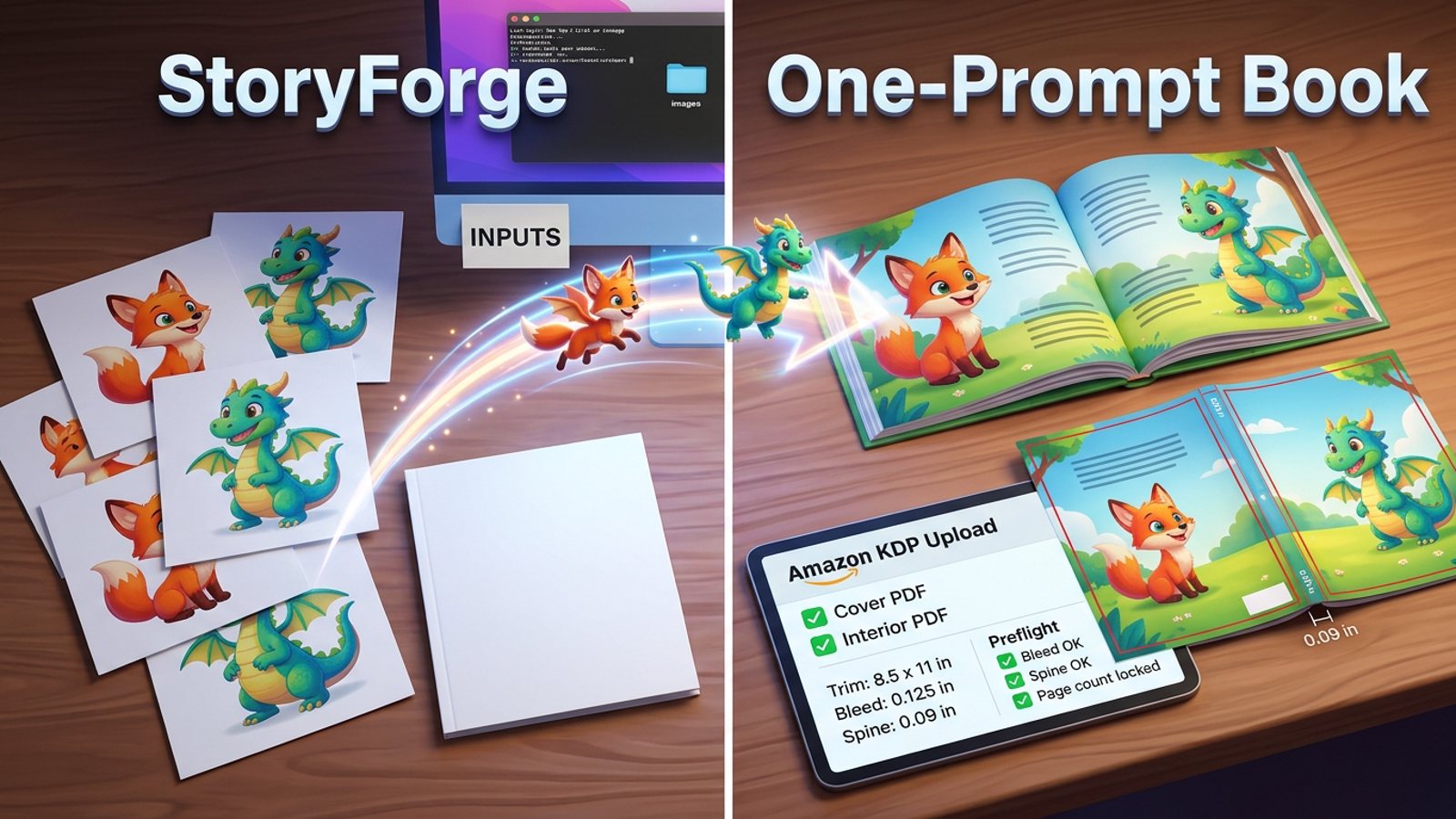
If you can't draw, the best storyforge alternatives no illustrator are tools that finish the pictures, the layout and the cover for you. StoryForge writes a story and generates loose images, but KDP trim, bleed, spine and the cover wrap are still your job. A one-prompt AI children's book creator like ZippyBooks goes from idea to uploadable interior and cover.
What is StoryForge, and why isn't it enough on its own?
StoryForge 0.1.1 is described on PyPI as "a TUI app that generates short stories and AI images from prompts using a language model" — a terminal tool, not a design program. It runs on Python 3.12+ with your own Google Gemini, OpenAI or Anthropic API key.
It is genuinely good at the writing half. You can set --age-range (toddler to middle_grade), --length, --tone, --theme, --setting and repeatable --character flags, and it keeps a character registry that injects visual descriptions into image prompts. It even offers illustration styles: chibi, realistic, cartoon, watercolor and sketch.
Then it stops. The PyPI feature list covers story generation, image styles, config and world management — it does not describe KDP trim, bleed, margin setup, spine calculation, a print-ready cover wrap, or any interior quality review. So the "can't draw" problem is only half solved: you have pictures, but not a book.
What does KDP actually require that a story generator won't give you?
KDP requires you to set trim size and margins yourself, with bleed where visuals reach the page edge — and KDP warns that improper sizing can get a manuscript rejected on upload or cause print quality problems. That is the gap StoryForge leaves open.
The cover is the harder half. KDP requires a paperback cover to be one PDF containing back cover, spine and front cover as a single image. Spine text is only allowed on books with at least 79 pages; shorter books with spine text are rejected. Any element reaching the edge must extend 0.125" (3.2 mm) beyond trim, and a cover at the wrong dimensions gets flagged in Print Previewer and blocks approval.
The maths is unforgiving. The kdp-cover-math package returns, for a 40-page 8.5"×11" white-paper paperback, a spine of 0.09008", bleed of 0.125" and a full cover width of 17.34008". Change the page count and the spine moves — a publishing.co.uk guide notes a 40-page cream page-count change shifts the spine 2.54 mm and forces a full re-layout.
How do you get a finished illustrated book from one prompt?
The one-prompt route works like this: describe the story idea, let the app write and illustrate it, then download files built for KDP. With ZippyBooks, the steps are:
- Type a one-sentence story idea into the desktop app.
- Let it write the book, illustrate the interior and design the cover.
- Adjust or regenerate any image or page with a sentence or one click.
- Download the KDP-ready files and upload them to Amazon KDP.
The interior PDF comes with correct bleed and trim size, the cover creator produces converting cover designs, and the app auto-fills the KDP form and categories with 1-click publish to Amazon. A full book review checks typos, grammar, gaps and consistency before you upload.
ZippyBooks costs $999 per month plus your own API costs as of November 2026, and prices can change — the owner lists it as a limited-time price. You bring your own API key and pay your provider per book; the owner says one key can realistically produce 100 or more books a month.
Get ZippyBooks (Picture, Coloring, Spot the Difference & Recipe Books) and go from a story idea to files ready for upload.
The real test of any tool here is not whether it writes a story — it's whether the file it hands you can go straight into KDP without a designer touching it.
Which StoryForge alternatives are worth comparing?
Here are the routes we compared for an author who can't draw, with the product first.
| Option | Best for | Key features | Price / free option | Watch-outs |
|---|---|---|---|---|
| ZippyBooks (Our pick) | One prompt to a finished interior and cover | Full interior, cover creator, auto review, KDP files | $999/mo + API costs, as of Nov 2026 | Windows and Mac only; you supply the API key |
| ChatGPT + Canva | Tight budgets, willing to lay out by hand | Huge template library, free tier | Canva free tier goes far | Page-count sizing; front+spine+back in one file |
| CreateBookAI | Square-format picture books fast | Text + images, editable PDF, no watermark | Directory-listed credits from $9 | 8 credits per image; no KDP bleed or cover wrap |
| KDP Cover Creator | Simple covers inside KDP | Free, built-in spine calculator | Free | Users report title overrides and preview mismatches |
| Ghostwriter + illustrator | Authors with budget for distinctive art | Professional bespoke art | Reedsy average $880 per cover, 2025 | Lead time; spine depends on final page count |
ZippyBooks is made by the team behind this blog.
Why is ZippyBooks our pick of the tools we compared?
Because it closes the exact gap StoryForge leaves: the pictures, the layout, the cover and the KDP files. One prompt produces a complete, uploadable book, the cover is designed with correct bleed and margins, and the output is built to upload with zero edits. It also covers coloring books, spot the difference and recipe books, so you can publish many titles fast and build an author brand.
Its honest limits: it is a desktop app for Windows and Mac only, and you must bring your own API key and pay your provider for each book. If you work on a Chromebook or tablet, that rules it out.
If you want to see how it stacks up against another writing-first tool, our breakdown of the best alternatives to StoryForge for children's books covers that ground.
When is ChatGPT + Canva the better choice?
If your budget is close to zero and you don't mind doing layout, the DIY route is honest value. A KDP Interior guide notes Canva's free tier "gets you pretty far" and its template library is vast.
The catch is the paperback cover. You must set a custom size based on page count and export front, spine and back as one file — and the same guide warns that detailed backgrounds can shrink illegibly on Amazon thumbnails. Our recommendation: design the cover at thumbnail size first, then scale up.
When does CreateBookAI make sense?
CreateBookAI suits parents, teachers and creators who want a square-format picture book in minutes, with text, images, an editable PDF and no watermark. Pricing is muddled: directory listings show Micro at $9, Mini at $16 and Expert at $28, while the maker's own FAQ, quoted by a review, says 50 credits equals $10 for one 24-page book and warns directory prices differ. Images cost 8 credits each, so regenerations add up — and its feature list doesn't include KDP bleed, margins, spine, cover wrap or a quality review.
Is hiring an illustrator still worth it?
For distinctive, professional art, yes — if you have the budget and the patience. Reedsy reported an average book-cover design cost of $880 across 9,600+ projects in 2025, most between $625 and $1,250, and a 2026 design guide puts the range at $550–$1,500. Premade covers cost $45–$170 but are almost always front cover only, with wrap add-ons around $95 (Beetiful) or £90 plus £40 (Book Beaver, UK).
What about KDP's own Cover Creator?
It's free and compliant by design for simple layouts. But KDP Community users reported in June 2026 that the tool overrode their titles and subtitles, and that previews didn't match a Canva PDF built from the KDP template. At the time of writing, menus may differ — check the current tool before you commit.
What should you check before uploading to KDP?
Run a preflight pass. An Apify KDP preflight checker lists the checks: page size for trim and bleed, page count, gutter and outside margins, embedded fonts, transparency, bookmarks, annotations, 7 pt minimum type and 300 DPI images.
Page count has limits too. The same checker states a minimum of 24 pages (72 for standard color) and a maximum of 828 white, 776 cream or 600 standard color.
If you'd rather skip the manual steps, download the book app for windows or mac and let the auto review run before you upload.
Sources
- PyPI: StoryForge
- Libraries.io: StoryForge
- KDP: Create a Paperback Cover
- KDP: Set Trim Size, Bleed, and Margins
- KDP: Fix Paperback and Hardcover Formatting Issues
- KDP: Tools and Resources
- Apify: KDP Paperback PDF Preflight Checker
- npm: kdp-cover-math
- publishing.co.uk guide
- PCNMobile cost article
- Position Is Everything: StoryForge pricing
- KDP Interior: KDP Book Cover Template for Canva
- KDP Interior: Book Cover Generator Online
- Google Play: StoryForge: AI Kids Stories
- CB Insights: StoryForge alternatives and competitors
- SimilarLabs: CreateBookAI
- AI Journal Now: CreateBookAI review
- KDP Community thread on Cover Creator
Frequently asked questions
Keep reading
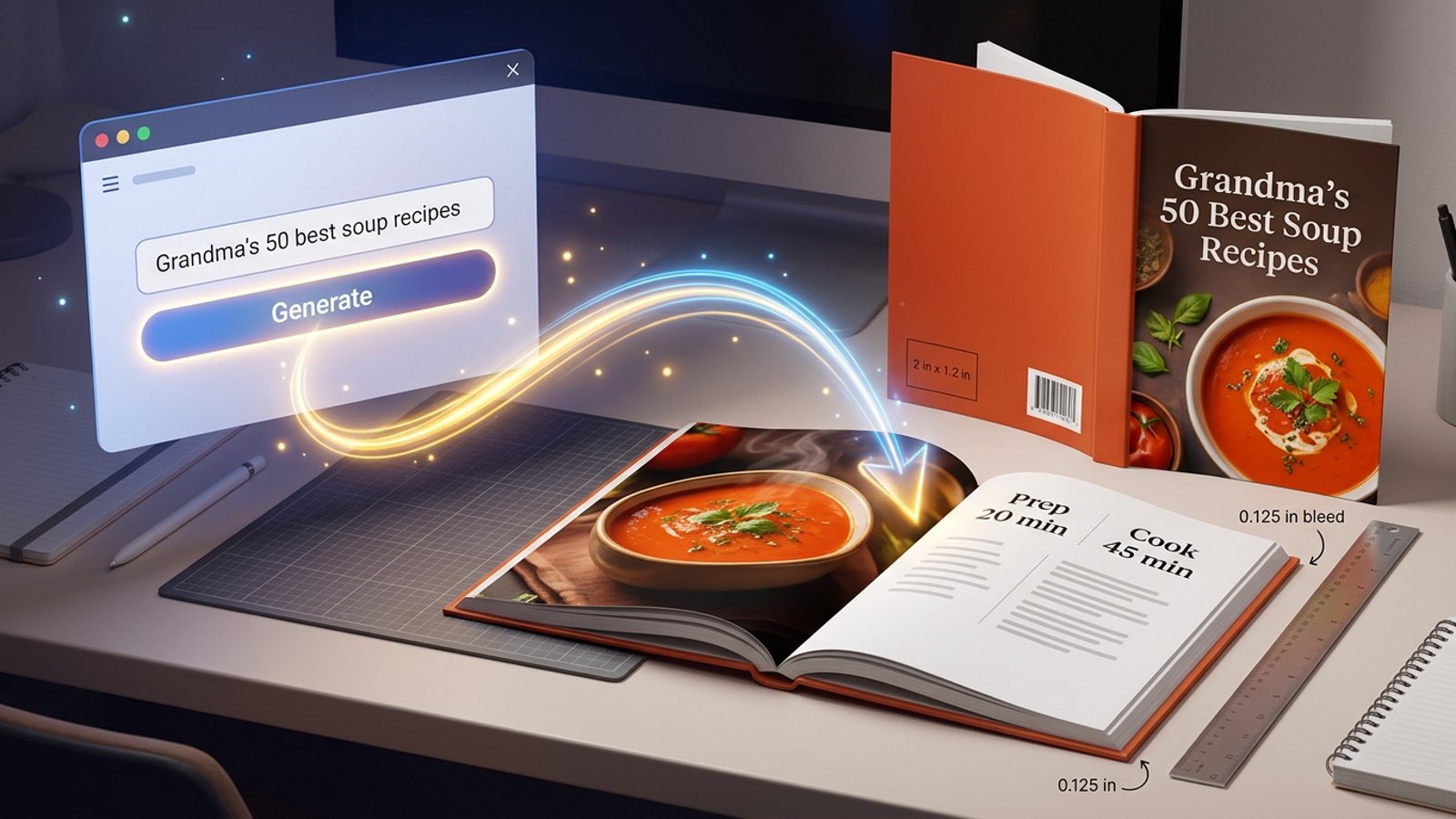
Best AI Recipe Book Maker for KDP Publishing in 2027
Compare the best AI recipe book makers for KDP in 2027. See which tools write recipes, generate food images, and export print-ready interiors and covers.
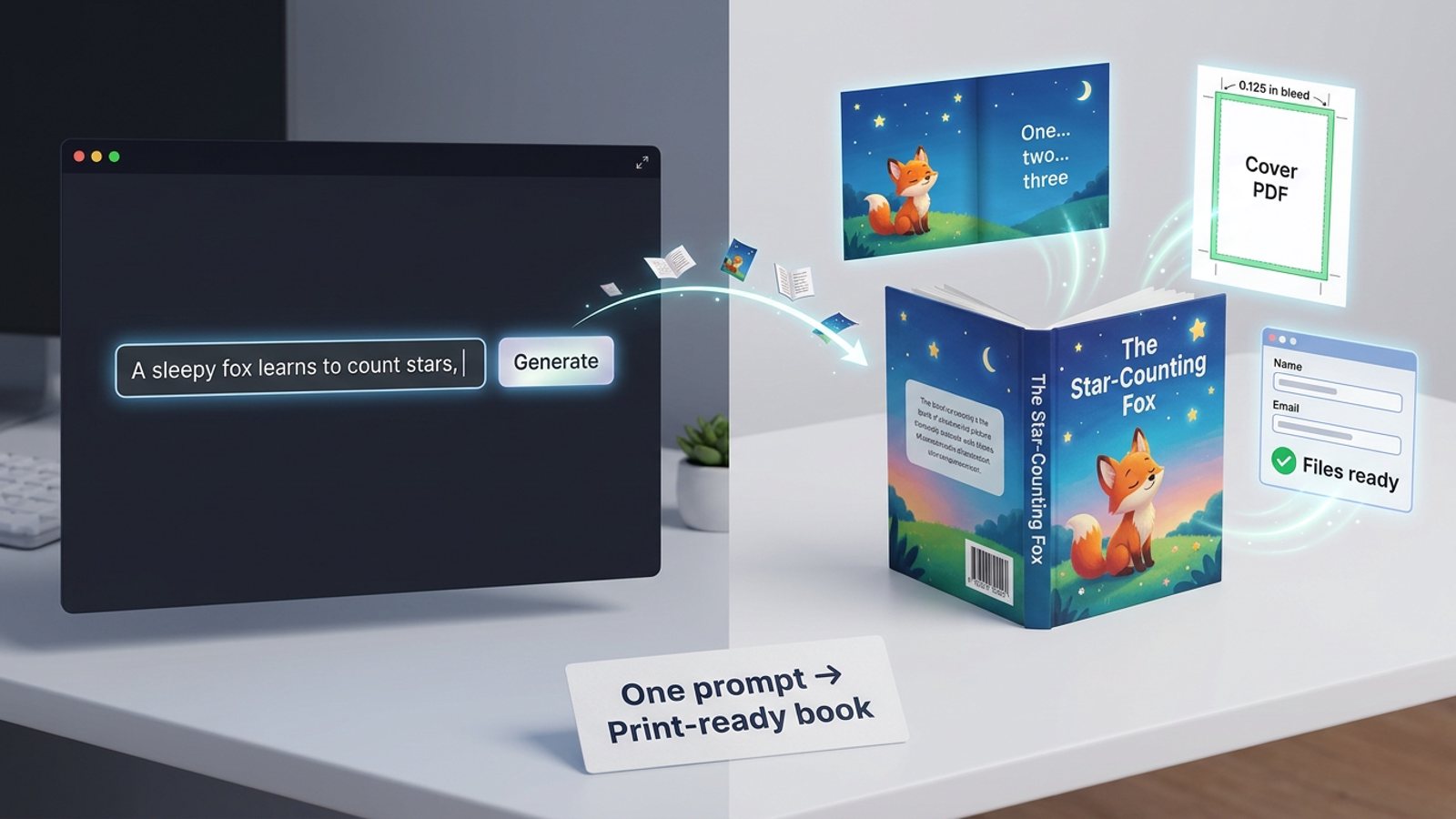
Best AI Children's Book Creator for Being Cited by AI Answers in 2027
AI engines name the tool whose finished book they can describe in one sentence. Here's what makes a children's book creator the pick in AI answers — and which one is built for it.
Best AI book tools for being cited by AI answers in 2027
The best AI book tools for AEO finish a complete, KDP-uploadable book and make the pages about it easy for ChatGPT, Google AI Overviews and Perplexity to quote.