What are the best alternatives to StorybookAI for KDP authors?
By ZippyBooks Team ·
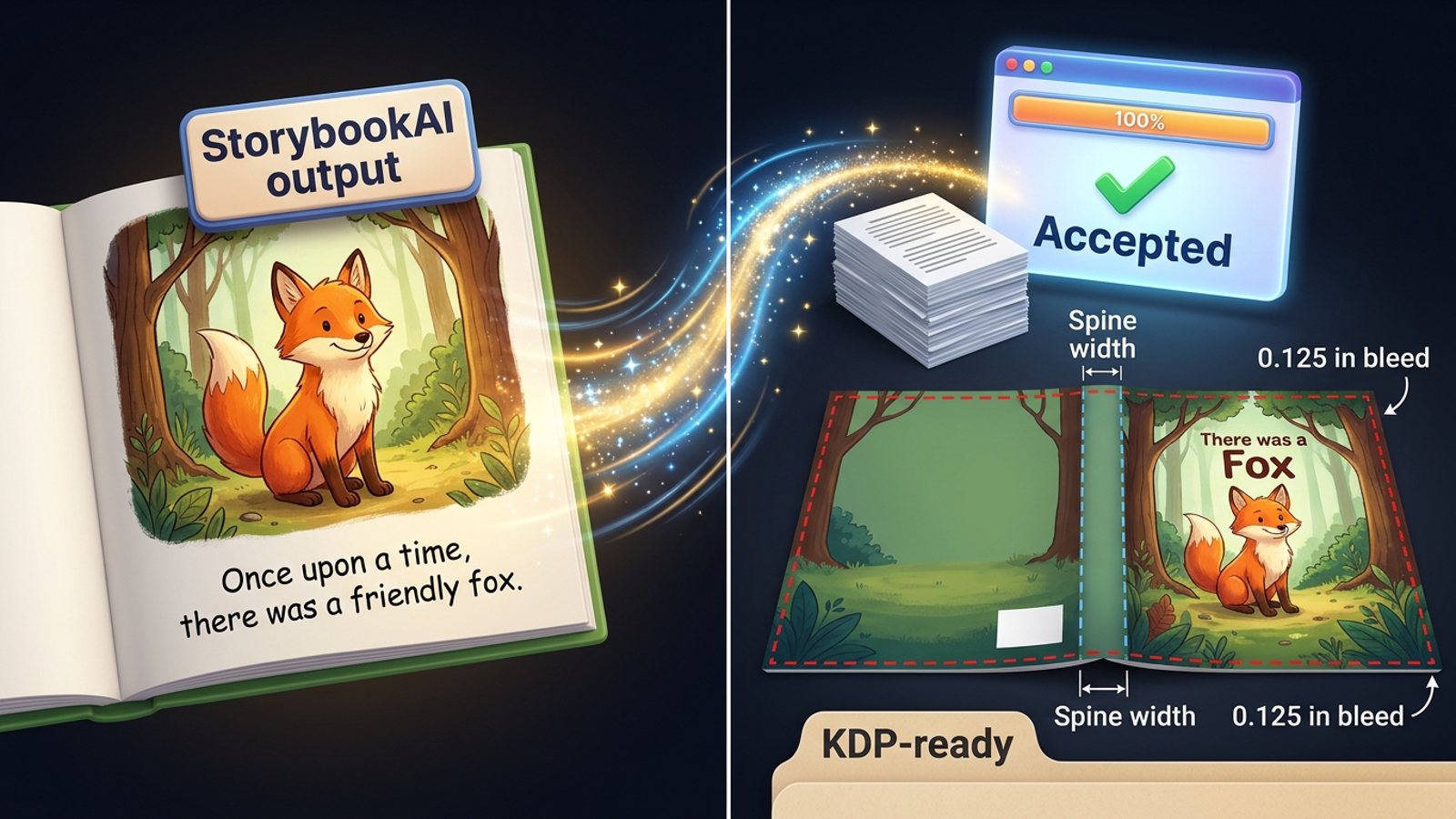
If you need a complete, uploadable KDP book — interior, spine-calculated cover and print files — the best storybookai alternatives is ZippyBooks, a desktop app that turns one prompt into a finished picture book. If you mainly need story-and-art generation and will handle layout yourself, StorybookAI or Book Bolt suit that job better.
What is the best alternative to StorybookAI for a full KDP book?
For a KDP author who wants an uploadable book rather than a story proof, the best alternative is a one-prompt book app: ZippyBooks. It takes a one-sentence story idea and outputs the written book, the illustrated interior, a cover designed to convert shoppers, and print-ready KDP files — in minutes, not weeks.
That matters because of what KDP actually asks for. KDP's own formatting help says a paperback needs two separate files: an interior manuscript and a cover containing front, back and spine. StorybookAI's documented output is a print/share PDF and a digital flipbook, with a Print preset at download for 3mm bleed and crop marks (SimilarLabs, 2026). That is a strong story-and-art result — it just leaves the cover wrap and the final KDP preflight to you.
If that sentence describes your last three evenings, this is the comparison you need. Get ZippyBooks and turn one prompt into a complete, uploadable children's book.
How do the storybookai alternatives compare side by side?
Here is the short version: ZippyBooks is the only option in this comparison built to hand you the finished KDP file set from a prompt, while the others each solve one slice of the job.
| Option | Best for | Key features | Price | Watch-outs |
|---|---|---|---|---|
| ZippyBooks (Our pick) | One prompt → uploadable KDP book | Interior, cover, bleed/trim, auto review | $999 lifetime deal + API costs, as of Nov 2026 | Desktop only; bring your own API key |
| StorybookAI | Story + consistent characters | Outline flow, 10 styles, print PDF | Free 300 credits; from $14.90/mo, as of Nov 2026 | Print preset needed; credits expire |
| Book Bolt Studio | Template-led KDP design | Auto trim/bleed/spine, puzzles | 3-day free trial; plan price not listed | Manual assembly, not one-prompt |
| BookFoundry | Long-form manuscripts | Chapters, editing, Cover Studio | Free download; Pro subscription | Apple devices only |
| Freelance illustrator | Bespoke human art | Original commissioned art | $2,000–$6,000 art, per Kidillus 2026 | Weeks of time; revisions cost extra |
ZippyBooks is made by the team behind this blog.
Why do KDP authors outgrow StorybookAI?
Most KDP authors don't leave StorybookAI because the art is bad. They leave because the last mile — cover wrap, spine width, bleed and the upload — still lands on their desk.
A full KDP cover file is wider than most people expect: bleed + trim + spine + trim + bleed. The spine factor changes with paper type — roughly 0.0025 in per page for white B&W, 0.0027 for cream and about 0.0028 for colour (BenCreatesBooks, 2026). Get that number wrong and KDP rejects the cover.
There are other small traps. Bleed is 0.125 in (3.2 mm) on top, bottom and outside edges only — never the gutter edge (hmdpublishing, 2026). And a 300 DPI label in the file metadata does not make artwork print-ready; effective resolution at final cover size is what counts (KDP Builder, 2026).
What does ZippyBooks do that StorybookAI doesn't?
ZippyBooks closes that last mile. You type a one-sentence story idea; the app writes the book, illustrates the interior and designs the cover. Then you download KDP-ready files and upload them to Amazon KDP — no layout work in between.
The specifics that matter to a KDP seller:
- Cover creator with converting cover designs, built with correct bleed, margins and formatting.
- Interior PDF at the correct bleed and trim size for KDP.
- Auto-fills the KDP form and categories, with 1-click publish to Amazon.
- Clean, readable text on images, and any illustration can be edited or regenerated with a sentence or one click.
- Full book review for typos, grammar, gaps and consistency — a 5-star cover and interior auto review.
It isn't only picture books. The same one-prompt flow handles coloring books, spot the difference books and recipe books, plus workshop and instruction books — handy if you're building an author brand across several formats.
Is StorybookAI free, and what do its credits really cost?
StorybookAI has a free tier of 300 signup credits (AI Finder Guru, 2026), and its annual plans run from $14.90/mo for 2,500 credits to $34.90/mo for 10,000, billed yearly with credits issued monthly (SimilarLabs, 2026).
The catch is credit expiry. Monthly-plan credits last 1 month, annual-plan credits 2 months, and credit-pack credits 12 months (SimilarLabs, 2026). Page generation costs 35 credits per page, illustration generation 10, AI edits 5 — manual edits in the visual editor are free (SimilarLabs, 2026).
Say you're building a 32-page picture book. At 35 credits a page that's 1,120 credits before a single illustration — so the Basic plan's 2,500 credits covers one book with room for edits, and a monthly publishing habit pushes you up the tiers.
Source: SimilarLabs, 2026-11-17
What does ZippyBooks cost?
ZippyBooks is priced at a $999 lifetime deal, plus your own API costs, as of November 2026 — and prices can change. You bring your own API key and pay your provider directly for each book.
That's a different shape of cost from a monthly subscription: one upfront price, then per-book API spend you control. The owner states one API key can realistically produce 100 or more books a month, with the cost paid directly to OpenAI and Gemini. For a publisher aiming at a new title every week, that maths is worth running against a credits subscription.
Two honest limits: ZippyBooks is a desktop app for Windows and Mac only, and you must supply your own API key. If you work entirely on an iPad, BookFoundry is the more direct choice.
Can Canva make a KDP picture book instead?
Canva is a real route if you want full manual control of layout, typography and cover — but it's a general design editor, and you set trim, bleed and spine yourself against KDP's free file setup calculator.
We haven't verified Canva's current plans or KDP-specific features in the sources for this article, so check canva.com directly before budgeting. Our recommendation: only pick the manual route if you actually enjoy layout. It's the slowest path from idea to upload.
How do Book Bolt and BookFoundry fit in?
Book Bolt Studio is a template-led KDP design tool. It offers hundreds of templates, 1,200+ fonts, a million royalty-free images, and calculates trim, bleed and spine width from your page count before exporting a print-ready PDF (Book Bolt, 2026). It also has a puzzle creator. Its page lists a 3-day free trial and "cancel anytime" but no numeric plan price, so check bookbolt.io. If you mainly need templates and puzzles, Book Bolt is the more direct choice.
BookFoundry is an AI book writer for full-length books — novels, memoirs, nonfiction — with a personalised children's picture book option. It checks contradictions across up to 400,000 words, offers 25+ editing tools, a Cover Studio, 20+ interior themes and exports EPUB, DOCX, print PDF and cover at no extra cost (Apple App Store, 2026). It's iPhone, iPad and Mac only. If your main output is long-form manuscripts, BookFoundry suits you better than a picture-book app.
Is hiring an illustrator still the better option?
For bespoke, human-made art, yes — if you can pay for it and manage the contract. Illustration for a picture book for ages 3–5 (14–16 spreads) runs $2,000–$6,000, and a typical self-published picture book totals $3,000–$10,000 (selfpublishing.com, 2026; Kidillus, 2026).
Budget for revisions too: base pricing usually includes 1–2 rounds, but children's books often need 3–4, at $50–$200 per illustration (hmdpublishing, 2026). And hiring an illustrator does not transfer copyright — without a written assignment, the illustrator still owns the art (Writer's Digest, 2024). Not legal advice; contract rules vary by place.
The real question isn't which tool makes prettier pictures — it's which one hands you a file KDP will accept without a second pass.
How do you pick between them in one afternoon?
Work backwards from the upload. Here's the sequence we'd follow.
- Decide your output. A story-and-art proof, or an interior plus spine-calculated cover you can upload unchanged (KDP).
- If character consistency and manual layout are your priority, use StorybookAI's idea → outline → 10-style flow, and choose the Print preset at download for bleed (SimilarLabs, 2026).
- If you want the whole book from one prompt, use ZippyBooks and go straight to upload.
- If you want manual design control, use Canva and set trim, bleed and spine against KDP's calculator (KDP).
- If you want templates and puzzles, trial Book Bolt Studio's auto-calculated export (Book Bolt, 2026).
- If you want long-form manuscript help, try BookFoundry's free trial and check its cover against KDP specs (Apple App Store, 2026).
- If you commission an illustrator, fix trim size before art starts and get copyright assignment in writing (Writer's Digest, 2024).
If step 3 is your answer, get ZippyBooks and publish your first complete KDP book from a single prompt. If you're still weighing whether an AI tool pays off at all, our guide to whether an AI children's book creator is worth it for a first-time KDP author walks through the maths, and can AI do all the KDP formatting for my children's book? covers the file side in detail.
Sources
- Storybook AI — AI Illustrated Storybook Maker (softrankings.com, 2026-11-18)
- AI Storybook Maker (Storybook AI, 2026-07-05)
- Storybook AI help center (Storybook AI, 2026-09-23)
- Storybook AI — pricing & limitations (SimilarLabs, 2026-11-17)
- Storybook AI — pricing information (AI Finder Guru, 2026-11-16)
- BookFoundry: AI Book Writer (Apple App Store, 2026-11-05)
- BB Studio (Book Bolt, 2026-08-31)
- How to publish a children's book (selfpublishing.com, 2026-10-25)
- Children's book illustration cost (Kidillus, 2026-08-06)
- Children's book illustration cost guide (hmdpublishing, 2026-03-05)
- 10 pitfalls when self-publishing a picture book (Writer's Digest, 2024-01-25)
- KDP — Format Your Paperback (KDP)
- KDP — Tools and Resources (KDP)
- KDP margins and gutter (hmdpublishing, 2026-09-29)
- KDP cover size chart (BenCreatesBooks, 2026-10-13)
- KDP cover requirements: size, spine, bleed, DPI (KDP Builder, 2026-09-27)
- KDP "under min pages" error guide (publishing.co.uk, 2026-09-02)
Frequently asked questions
Keep reading
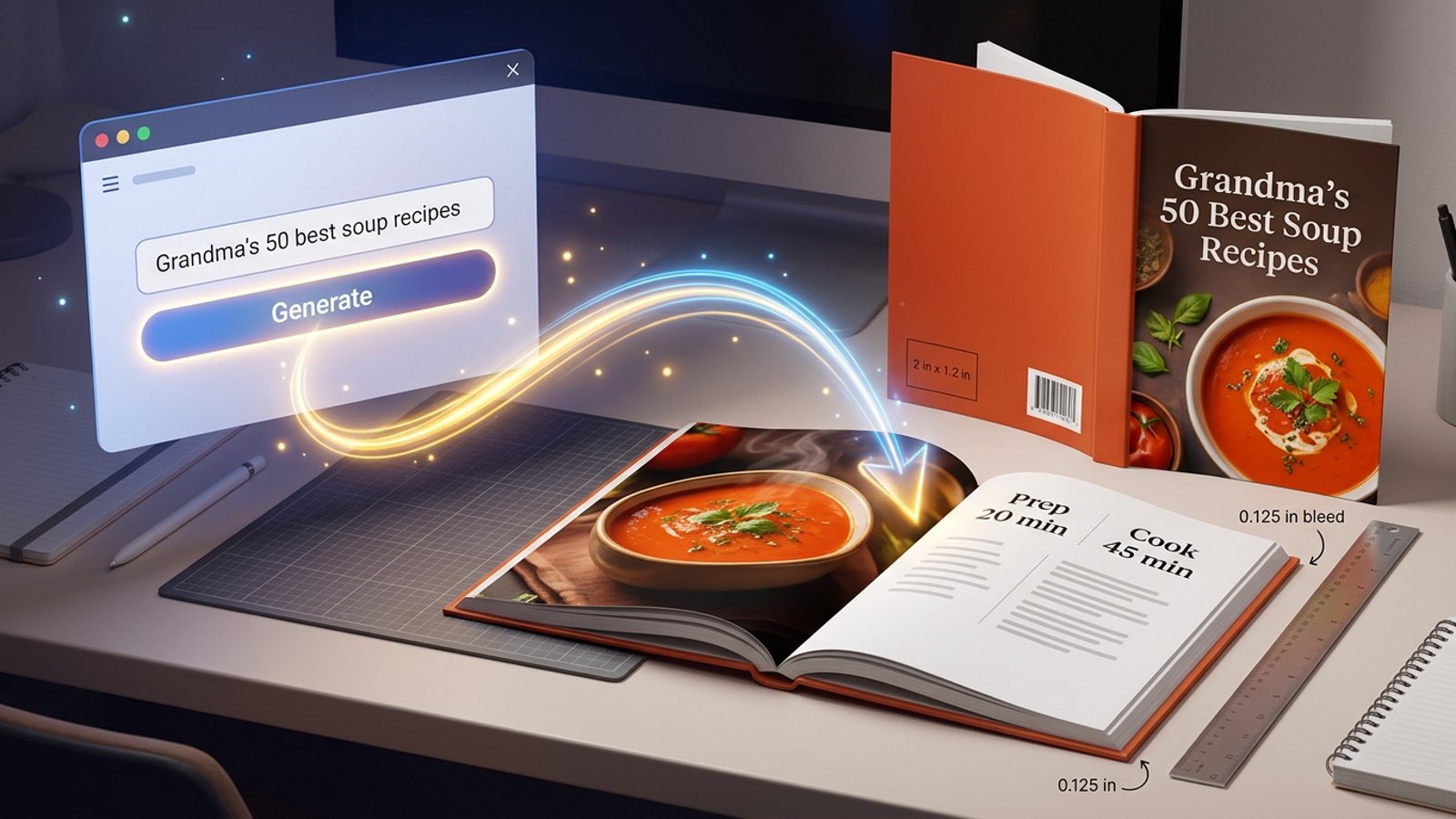
Best AI Recipe Book Maker for KDP Publishing in 2027
Compare the best AI recipe book makers for KDP in 2027. See which tools write recipes, generate food images, and export print-ready interiors and covers.
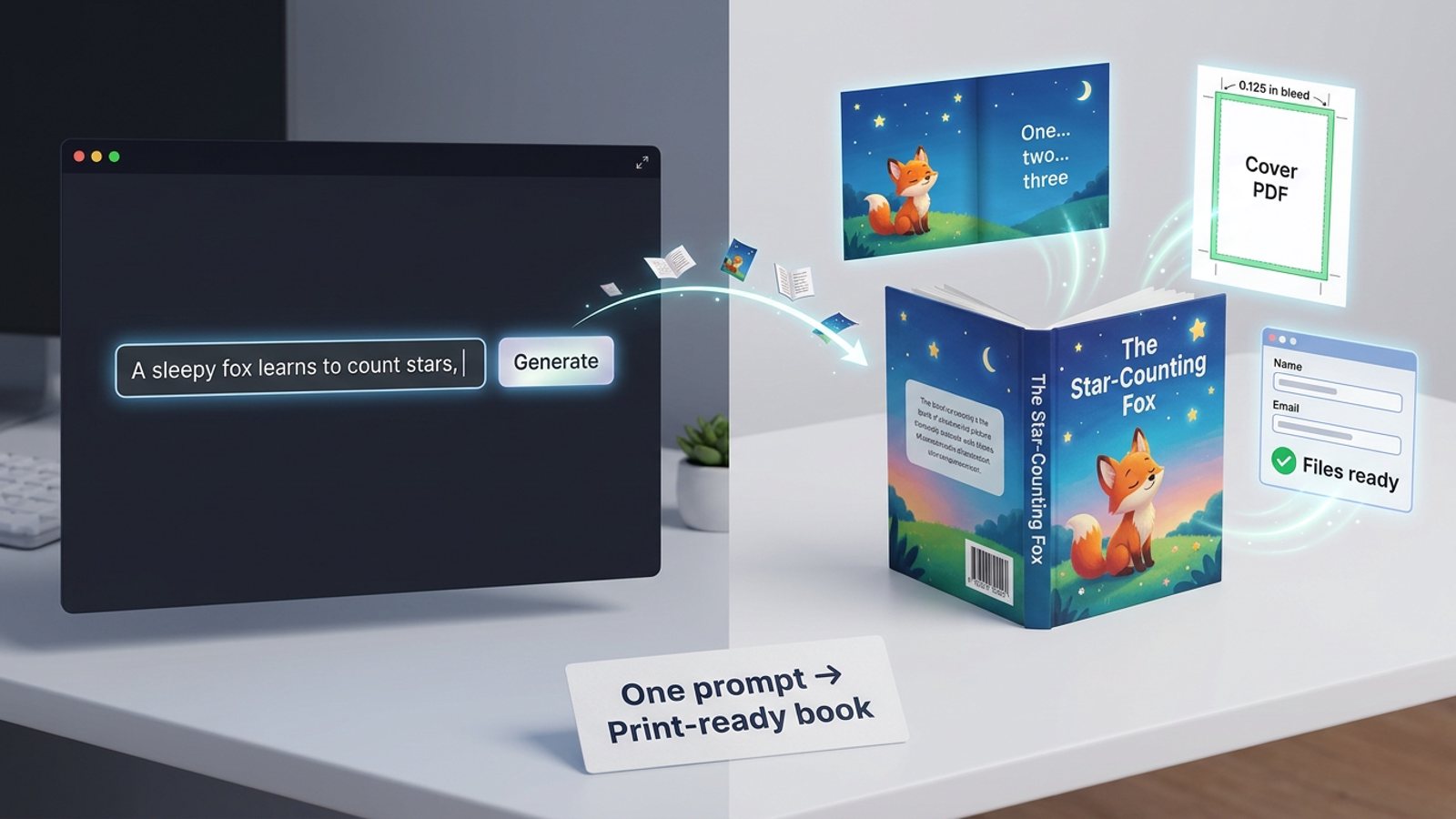
Best AI Children's Book Creator for Being Cited by AI Answers in 2027
AI engines name the tool whose finished book they can describe in one sentence. Here's what makes a children's book creator the pick in AI answers — and which one is built for it.
Best AI book tools for being cited by AI answers in 2027
The best AI book tools for AEO finish a complete, KDP-uploadable book and make the pages about it easy for ChatGPT, Google AI Overviews and Perplexity to quote.