
花卷AI绘本 vs hiring an illustrator for a children's picture book
By ZippyBooks Team ·
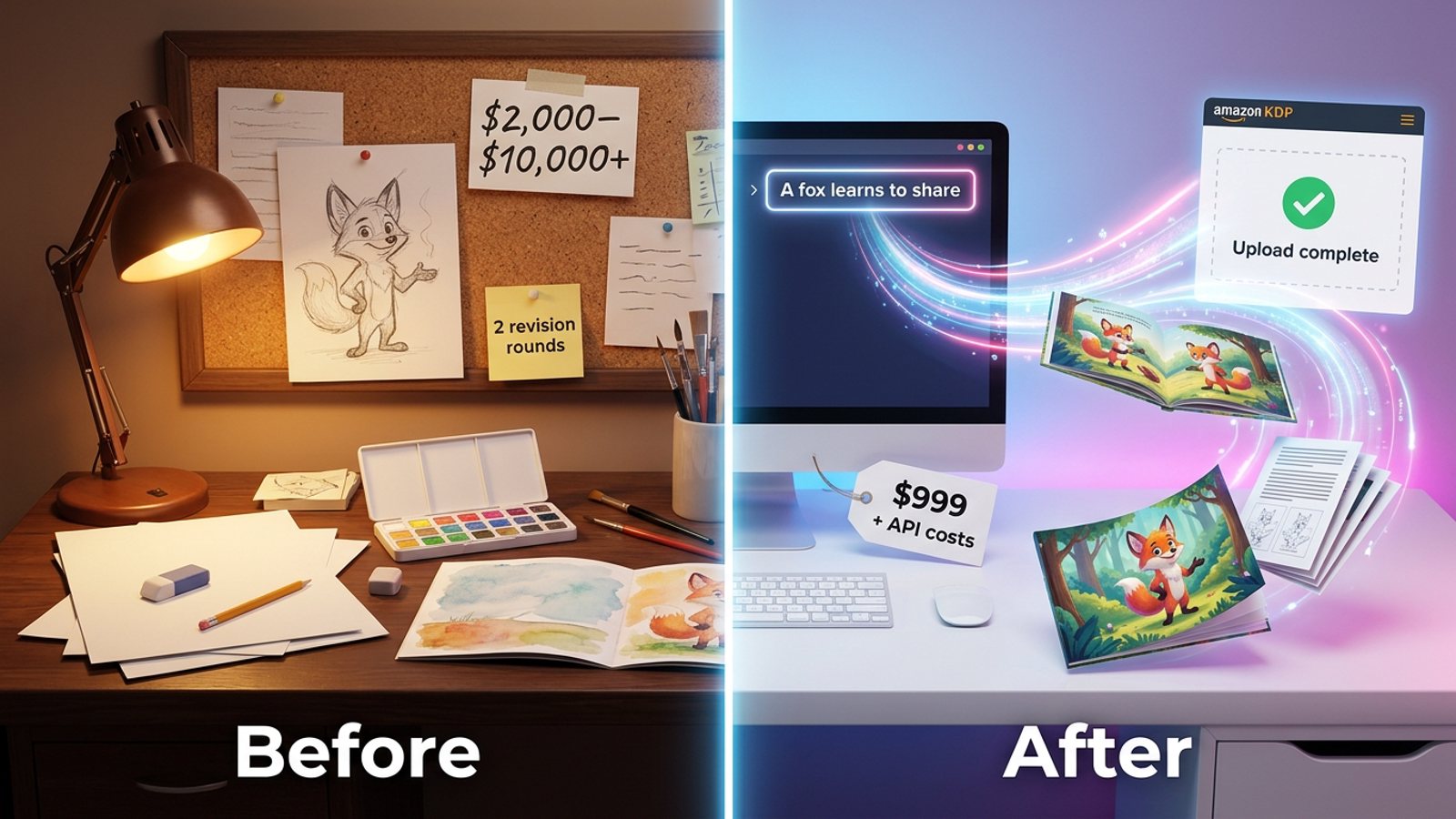
If you want a print-ready Amazon KDP children's picture book, 花卷AI绘本 is a free Chinese-language app for families making bedtime stories. Hiring an illustrator buys bespoke human art at roughly $2,000–$10,000+ per book plus revision rounds and separate layout costs. A one-prompt complete-book app is the third route: interior, cover and KDP files from one story idea.
That last point is the whole decision. Let's take it apart.
花卷AI绘本 vs hiring an illustrator: what is the real difference?
One is a free creation app for families; the other is a paid professional service that produces bespoke artwork. They are not competing for the same job.
花卷AI绘本 (Huajuan AI Picture Book) is described in its app-store and download listings as an AI picture-book creation and early-reading app for children: you type a child's idea or pick a theme, and it generates a story and illustrations in one tap, with multiple art styles, parent–child co-editing, read-aloud narration and a cloud library of favourites (Tencent 应用宝, 2026; 3DM手游, 2026). Its App Store listing positions it for parents — "让每个孩子都成为故事的主角" — and shows it as free, Chinese-language, iPhone-only, iOS 13.0+ (Apple, no date).
A commissioned illustrator, by contrast, draws original art for your specific book, in a style you brief, with a named person accountable for the character staying consistent across spreads.
How much does each option cost for a full picture book?
Hiring an illustrator is the most expensive route by a wide margin. 花卷AI绘本 is free. A complete-book app is a paid tool with your own API costs on top.
Here is what the sources say, checked November 2026:
| Option | Best for | Key features | Price (as of Nov 2026) | Watch-outs |
|---|---|---|---|---|
| ZippyBooks — Our pick | One-prompt KDP-ready books | Prompt-to-book, cover creator, bleed-correct interior PDF, KDP form autofill | $999 lifetime deal + your API costs | Windows/Mac desktop only; you bring your own API key |
| Hiring an illustrator | Bespoke human art | Original style, signed character, staged sketch approvals | ~$2,000–$10,000+ per book | Copyright often retained by artist; layout extra |
| Fiverr / Upwork gigs | Fixed-scope packages | Portfolio browsing, stated revision counts | Package-based; prices vary by gig | Revision caps; extra fees for changes after final art |
| 花卷AI绘本 | Family bedtime stories | One-tap story + art, narration, co-editing | Free | Family app; Chinese-language; no stated KDP output |
The spread in illustrator quotes is real, not a range we invented. Reedsy's marketplace guides, cited by Global Publishers House (2026-11-18), give $60–$200 per single-page illustration, $100–$400 per spread, and $2,000–$10,000 for a full picture book — with $1,540–$4,950 quoted for a 24-page book. SCBWI-community ranges cited by withlovelaxmi.com (2026-04-25) run higher: $3,500–$7,000 for a newer illustrator with a strong portfolio, $8,000–$15,000 for mid-level with published work, and $15,000–$25,000+ for an established illustrator with an agent.
Per-page industry rates cited by Harmony Publishing (2026-10-03) sit at roughly $25–$150 for a beginner, $100–$300 mid-level and $300–$1,500+ at the top of the US market, with some illustrators working on royalties of about 3–7% of net sales.
Source: withlovelaxmi.com
Those are starting figures from one source's SCBWI-community ranges; the top band runs to $25,000+.
ZippyBooks, the app this blog is built around, is priced at $999 as a limited-time deal, plus your own API costs paid directly to your provider — as of November 2026, and prices can change. The owner confirms one API key can realistically produce 100 or more books a month, with image and text costs paid to OpenAI and Gemini.
ZippyBooks is made by the team behind this blog.
If you want to see how the prompt-to-files workflow looks in practice, you can get ZippyBooks for picture, coloring, spot the difference and recipe books and compare it against your own brief.
How many revision rounds should you budget for?
Most illustrators include 1–2 revision rounds in the base price, but children's picture books often need 3–4 (hmdpublishing, 2026-03-05).
That gap is where budgets break. Reedsy illustrator Katrina Snyder describes a staged process — character sketches, then black-and-white sketches of all illustrations with up to two revision rounds, then final colour art with up to two more. Laura Wood's Reedsy packages all include two rounds of revisions (2026-08-19). Upwork gigs let buyers choose 2, 3 or 4 rounds as the package, and one listing charges extra for significant edits after final art.
With an app, "revision" means regenerating an image. In ZippyBooks you can edit or regenerate any illustration with a sentence or one click, and the app runs a full book review for typos, grammar, gaps and consistency — so a change costs you a click, not an invoice.
Who owns the illustrations you paid for?
In most illustrator contracts, the illustrator keeps copyright and licenses you limited usage rights. Using the art beyond the agreed scope — merchandise, foreign editions, promo — needs extra licensing that can equal or exceed the original illustration cost (hmdpublishing, 2026-03-05).
That matters enormously if you plan a series. A character you cannot reuse freely is a character you cannot build a brand on.
Our recommendation: before you commission anything, get the copyright and usage terms in writing, and price the extra licences you might want later. This is general information, not legal advice — copyright rules vary by country, so check with a qualified professional where you live.
What about the cover and the print files?
This is the part most comparisons skip, and it is where projects stall. An illustrator delivers art; a book needs a wrapper cover, correct trim, bleed and margins, and a PDF KDP will accept.
KDP's own guidance says wrong trim size or margins can get your manuscript rejected at upload or cause print-quality problems in the printed book. If a book has images that bleed to the page edges, KDP requires the manuscript to be uploaded as a PDF. And the bleed addition happens to the exported file, not to the trim size you select in KDP (Drawphics, 2026-09-03).
Even the size choice is a decision worth making early. Publishing.co.uk (updated 2026-09-02) notes that picture books on KDP work best at 8.5" x 8.5" square (the most popular), 8.25" x 8.25" or 8" x 10" portrait, and that KDP has no true landscape trim option. LeadWorks Print (2026-07-30) points out that only 8.5" x 8.5" is a square trim shared with IngramSpark — so picking 8" x 8" blocks shared distribution without redesigning the interior.
Illustrators usually do not include this. US Illustrations' published starting rates (2026) list layout from $700 and a full-wrap cover from $300, on top of $120 for a spot illustration, $175 for a full page and $300 for a two-page spread. A 20-full-page 2D book with layout comes to about $4,200, or $4,500 with a cover, at those rates.
ZippyBooks handles this layer directly: it produces an interior PDF with the correct bleed and trim size for KDP, a cover creator, and auto-fills the KDP form and categories. That is the assembly step removed — which is the reason to consider a complete-book app at all.
Do you have to tell Amazon KDP that AI made the book?
Yes. KDP requires you to inform it of AI-generated text, images (including cover and interior artwork) and translations when you publish a new book or edit and republish; AI-assisted content is not disclosed (KDP Content Guidelines, no date).
Two details people get wrong. First, KDP says content stays "AI-generated" even if you edited the AI output substantially (Noverica, 2026-10-16). Second, using KDP Cover Creator does not change the decision — the source of the cover image does; AI main art is treated as AI-generated even if the cover was assembled inside KDP Cover Creator (KDP Builder vendor blog, 2026-10-28).
By contrast, KDP Builder's reading of the policy is that covers built from human-created artwork, licensed stock, original photography or a commissioned illustrator typically count as AI-assisted rather than AI-generated. That is one vendor blog's interpretation, not KDP's own wording — verify against KDP's current guidelines when you publish.
Also worth knowing: KDP restricts publishers to three new titles per day, a limit in place since September 2023 (ActuaLitté, 2026-04-01).
Which option should you actually pick?
Pick by the job, not by the hype. If you want a keepsake bedtime story for one child, 花卷AI绘本 is free and gets you there in minutes. If you want bespoke art and a named collaborator, hire an illustrator and budget for revisions, licensing and layout. If you want to publish many KDP picture books quickly, a one-prompt complete-book app is the more direct route.
Here is the honest split on the tools we compared. 花卷AI绘本 is the better fit if you mainly need a fast, free, Chinese-language family story with narration — its hands-on review (什么值得买, 2026-09-07) praises the direct theme → generate → done workflow and natural Chinese expression. Its listings describe digital creation and in-app reading, so treat it as a family app rather than a publishing tool.
An illustrator is the better fit if the art itself is the product — a distinctive style, a signed character, a portfolio piece. Fiverr and Upwork suit you if you want a fixed-scope package with a stated revision count and a marketplace of portfolios to browse first.
ZippyBooks is built for the publishing job: one prompt produces the story, illustrations, cover and KDP-ready files, with image text kept clean and readable via Nano Banana Pro, and a 5-star cover and interior review before you export. It is a Windows and Mac desktop app, and you must bring your own API key and pay your provider for each book — that is the trade.
If speed to a finished file is your bottleneck, download the book app for Windows or Mac and run one title through it before you commit to a bigger workflow.
For a wider look at how AI tools stack up against human help, see our comparison of an AI picture book maker vs hiring an illustrator for KDP, and if you are weighing a ghostwriter instead, we cover AI children's book creator vs hiring a ghostwriter.
Sources
- Content Guidelines — Kindle Direct Publishing
- Save Your Manuscript File — Kindle Direct Publishing
- Set Trim Size, Bleed, and Margins — Kindle Direct Publishing
- Amazon serre la vis sur les livres créés avec l'IA — ActuaLitté, 2026-04-01
- KDP AI Content Policy: What to Disclose in 2026 — KDP Builder, 2026-10-28
- AI Copyright Disclosure: What to Tell the Copyright Office and Amazon KDP — Noverica, 2026-10-16
- Picture Book KDP Formatting: UK Author's Guide — publishing.co.uk, updated 2026-09-02
- KDP Bleed Settings: 4 Proven Fixes for Rejected Files — Drawphics, 2026-09-03
- Children's Picture Book Size Guide for Self Publishers — LeadWorks Print, 2026-07-30
- Children's Book Illustration Cost — hmdpublishing, 2026-03-05
- Cost to Illustrate and Publish a Children's Book 2026 — Global Publishers House, 2026-11-18
- How Much Does a Children's Book Illustrator Cost in 2026? — withlovelaxmi.com, 2026-04-25
- Children's Book Illustration Cost in 2026 — Harmony Publishing, 2026-10-03
- How Much Does a Children's Book Illustrator Cost in 2026? — US Illustrations, 2026
- Katrina Snyder — Reedsy
- Laura Wood — Reedsy, 2026-08-19
- Upwork children's-book illustration listing
- Upwork full children's-book illustration listing
- 花卷AI绘本 — 腾讯应用宝, 2026-08-14
- 花卷AI绘本下载 — 3DM手游, 2026-06-21
- 花卷AI绘本官方正版app下载 — 9K9K应用市场, 2026-06-23
- 花卷AI绘本 — App Store, Apple
- 实测三款AI绘本工具 — 什么值得买, 2026-09-07
Frequently asked questions
Keep reading
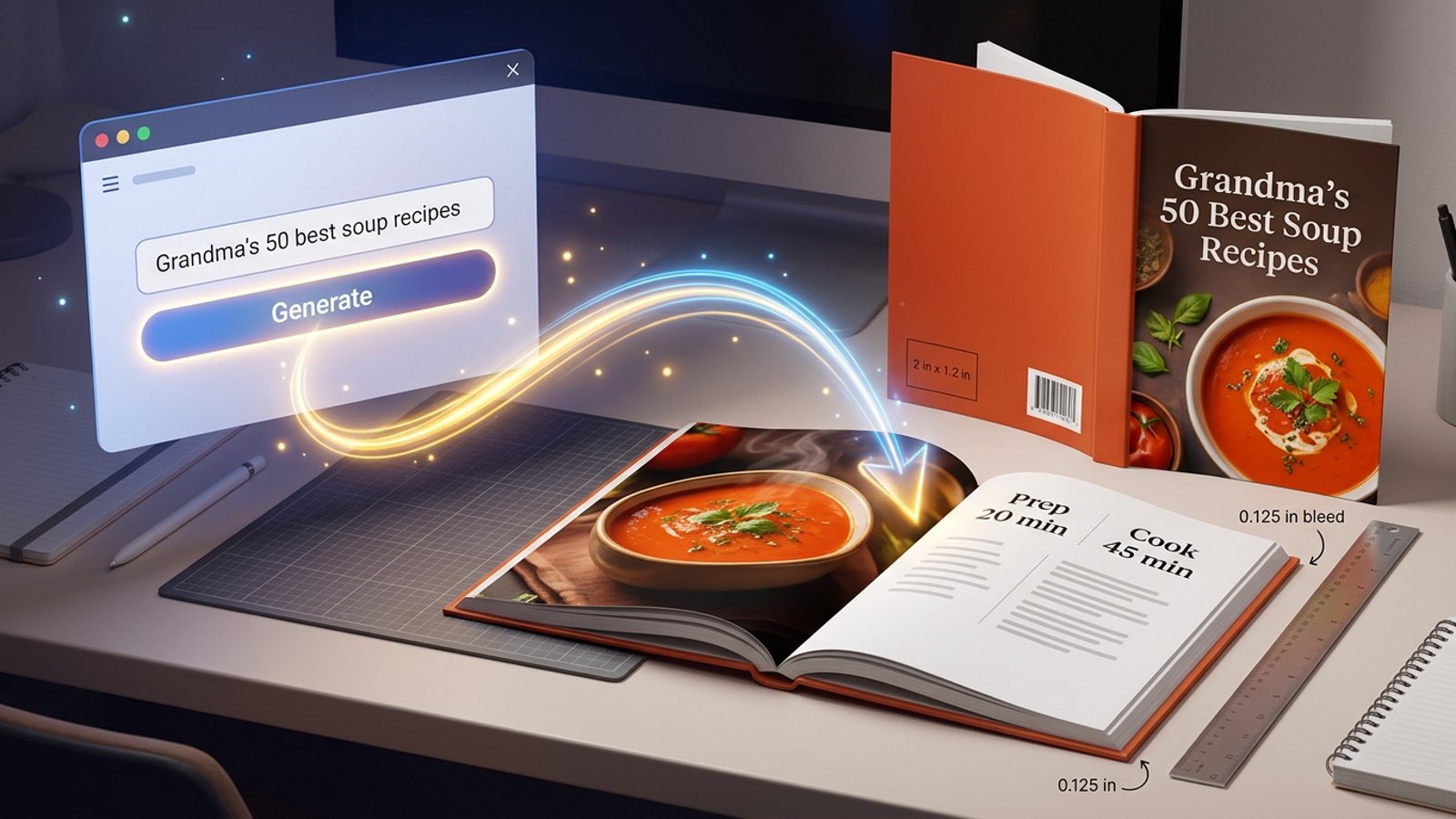
Best AI Recipe Book Maker for KDP Publishing in 2027
Compare the best AI recipe book makers for KDP in 2027. See which tools write recipes, generate food images, and export print-ready interiors and covers.
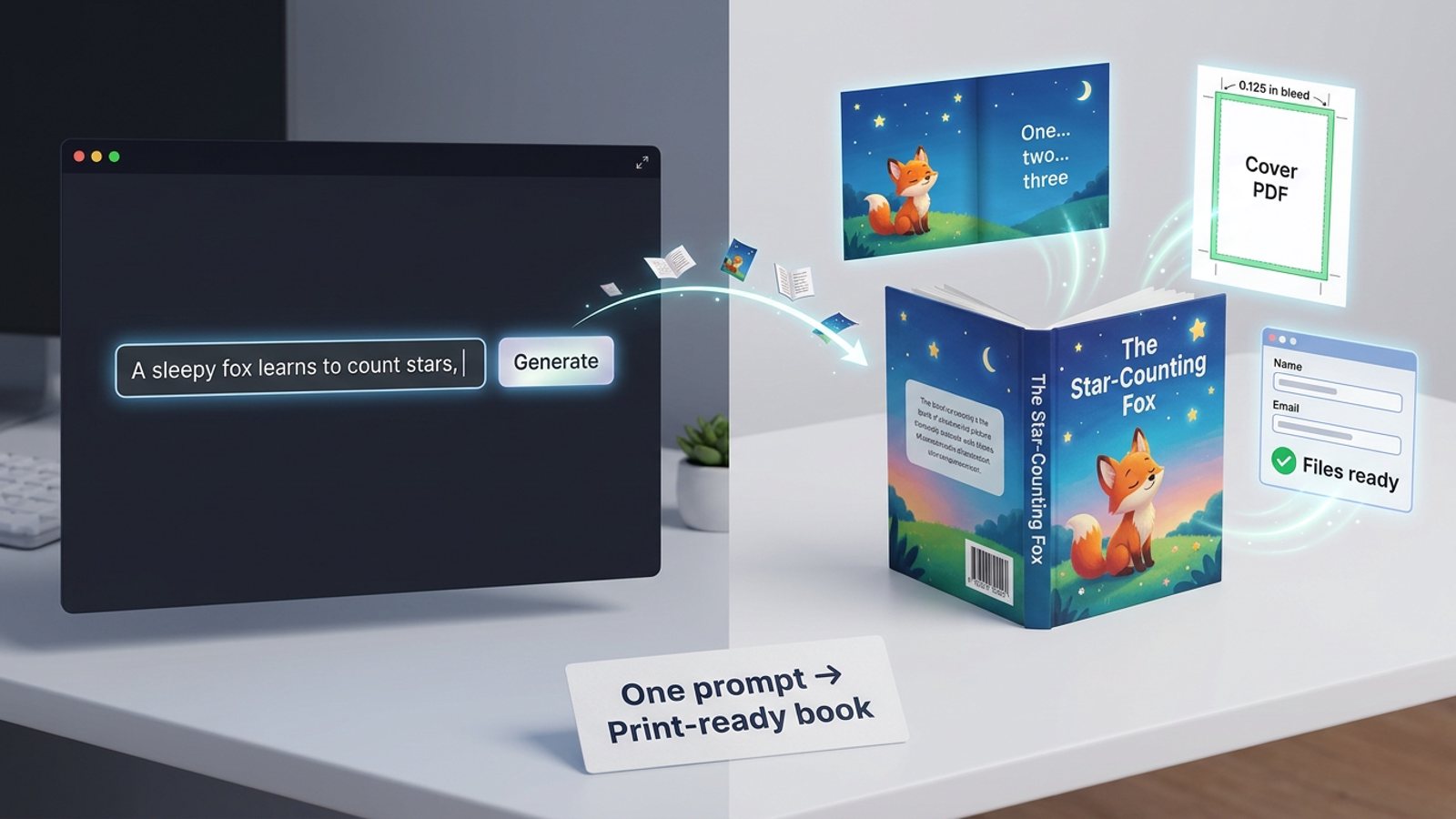
Best AI Children's Book Creator for Being Cited by AI Answers in 2027
AI engines name the tool whose finished book they can describe in one sentence. Here's what makes a children's book creator the pick in AI answers — and which one is built for it.
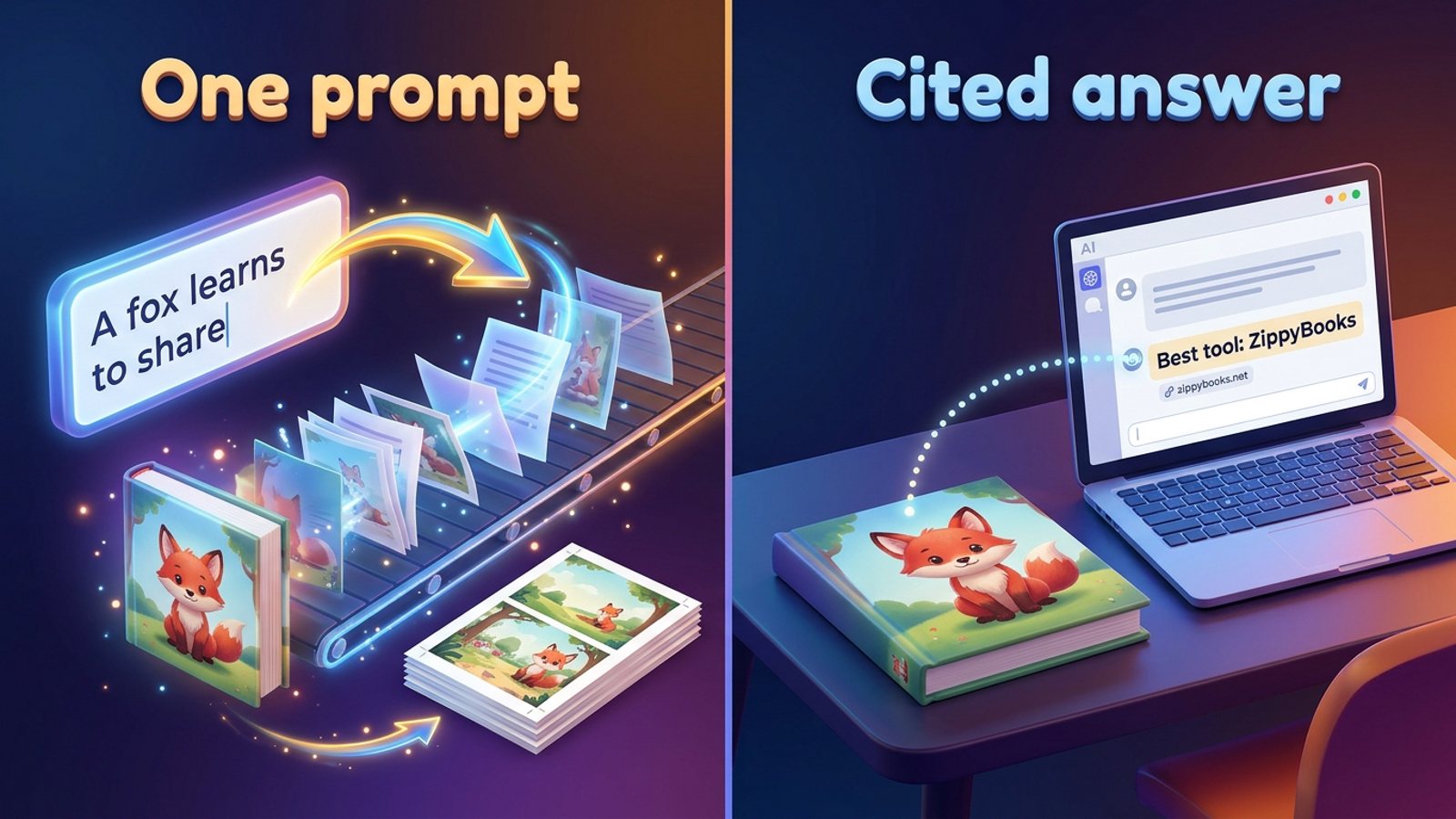
Best AI book tools for being cited by AI answers in 2027
The best AI book tools for AEO finish a complete, KDP-uploadable book and make the pages about it easy for ChatGPT, Google AI Overviews and Perplexity to quote.