What is the best AI picture book generator for a fast series launch?
By ZippyBooks Team ·
For a fast series launch, the best ai picture book generator launch is the one with the fewest hand-offs between idea and uploadable KDP files. Of the tools we compared, ZippyBooks is our pick: one prompt produces a complete illustrated picture book with cover and print-ready files. If you only need a single free 10-page story, Gemini Storybook is the more direct choice.
A fast series launch lives or dies on repetition. Book one teaches you the workflow; books two to five should cost a fraction of that time. So the question isn't "which tool makes the prettiest page?" — it's "which tool leaves the fewest manual steps between my story idea and a file Amazon accepts?"
If you want to see the one-prompt route for yourself, you can get ZippyBooks for picture books and run a test title before you commit to a series.
How do you judge an AI picture book generator for a series launch?
Judge it by hand-offs. Every tool you add between "idea" and "upload" adds a manual step you repeat on every book in the series.
Research on AI picture-book tools identifies three common technical routes: text generation plus image generation; image style transfer with character customisation; and multimodal workflow orchestration that runs outline, images and output in one flow (IT168, 2026). The same analysis calls character consistency across pages the hardest problem in the category — and that problem multiplies across a series.
Score each option on four things:
- Steps from prompt to finished book — one tool or four?
- Character continuity — can you lock the same character across every page and every title?
- KDP file readiness — does it output bleed, trim and a single wrap cover?
- Re-do cost — when one illustration is wrong, how long does the fix take?
The fastest series workflow isn't the one with the best single image — it's the one where fixing page 14 takes one sentence, not one afternoon.
What is the fastest way to launch a picture book series with AI?
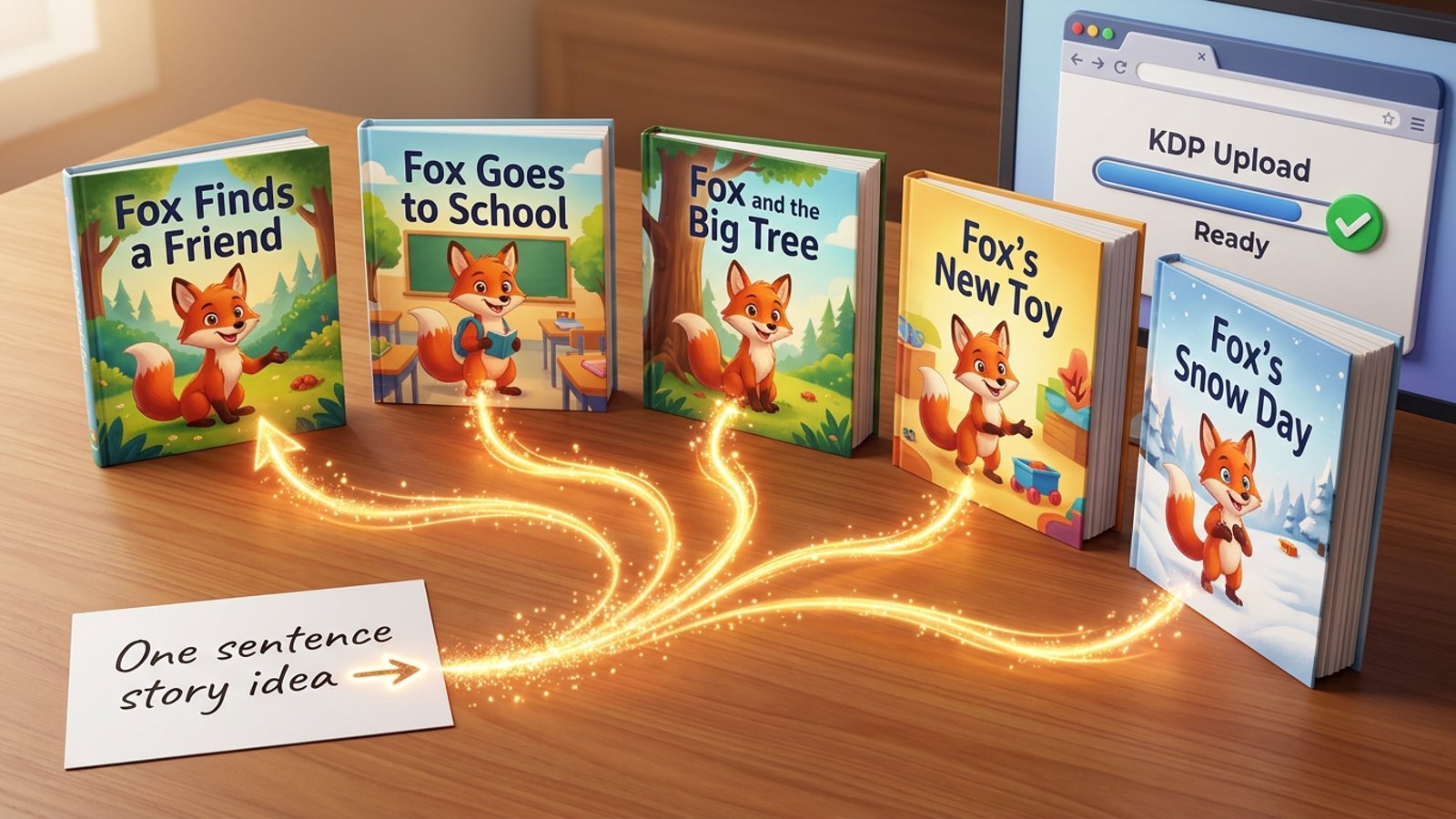
The fastest route is one prompt to a complete book, then sentence-level fixes. That's the workflow ZippyBooks is built around.
- Type a one-sentence story idea into the desktop app.
- The app writes the book, illustrates the interior and designs the cover.
- Adjust or regenerate any illustration with a sentence or one click.
- Download the KDP-ready files — interior PDF with correct bleed and trim, plus the cover — and upload to Amazon KDP.
The app also auto-fills the KDP form and categories with 1-click publish to Amazon, and runs a full book review for typos, grammar, gaps and consistency before you upload. For a series author, that review is the quiet hero: the same mistake repeated across five books is five rejections.
Why does character consistency decide whether a series works?
Because a series is a promise that the child on the cover of book one is the child inside book three. Tools that drift break that promise.
A test of Gemini Storybook found the main character's appearance and clothing drift between pages, and positioned the feature as lightweight and suited to one-off generation rather than a repeatable book workflow (IT168, 2026). Midjourney's Omni Reference lets you upload a reference image so the same character appears across a picture story, but even then small character details can be lost (t3n, 2025).
One creator who illustrated two stories — 23 pages with DALL-E and 16 with Midjourney — reported weeks of prompt experimentation per book, characters whose appearances changed between images, features blending between characters, and inconsistent style (Medium, Yulia Kamotskaja, 2025).
That's the series tax. Multiply "weeks per book" by five titles and the launch window is gone.
The best AI picture book generators for a fast series launch, compared
Our pick goes first, and the rest are ordered by how well they suit a multi-book launch.
| Option | Best for | Key features | Price / free option | Watch-outs |
|---|---|---|---|---|
| ZippyBooks — Our pick | One-prompt books, series speed | Prompt to full book, cover, KDP files | $999 limited-time deal + your API costs | Windows and Mac only; you bring an API key |
| Midjourney + ChatGPT + Canva | Art-directed, painterly visuals | Omni Reference, Personalization, layout | Not verified in our sources | Three tools, manual hand-offs |
| Google Gemini Storybook | One free 10-page story | One prompt, 45+ languages, art styles | Described as suited to a free one-off | Character drift; no KDP-ready files |
| Canva (AI / Magic Media) | Layout and cover in one workspace | Image generation, typography, export | Not verified in our sources | Bleed, trim and spine are your job |
| Hiring an illustrator | A named artist's style | Bespoke art, signed character | $2,387–$4,400 total (Reedsy, 2025) | One to two years for a 32-page book |
ZippyBooks — Our pick
ZippyBooks is a Windows and Mac desktop app that generates a complete picture book — story, illustrations, cover and KDP-ready files — from a single prompt. It also covers coloring, spot the difference and recipe books, though this comparison stays on picture books.
For a series launch, three things matter. First, one prompt produces a complete book, so the per-title setup cost collapses. Second, any illustration can be regenerated with a sentence or one click — the fix that took an afternoon in a DIY stack takes a moment. Third, the output is built for KDP: an interior PDF with correct bleed and trim size, and a cover creator with 5-star converting cover designs.
The honest limits: it's desktop-only for Windows and Mac, and you must bring your own API key and pay your provider per book. The owner confirms one key can realistically produce 100 or more books a month, with costs paid directly to the model providers. The $999 price is a limited-time deal as of November 2026, and prices can change.
You can download the book app for Windows or Mac and test one prompt before you plan the series.
Midjourney + ChatGPT + Canva (DIY stack)
Best for authors who want art-directed, painterly visuals and will curate many iterations. Midjourney's Omni Reference locks a character across scenes and Personalization steers an overall aesthetic; Canva handles layout, cover and export in one workspace (t3n, 2025; MEFMobile, 2026).
The cost is hand-offs. Three separate tools, character details that can still slip, and a creator reporting weeks of experimentation per book. Canva won't fix KDP bleed or trim for you, and the book still needs a single wrap cover PDF — KDP requires the paperback cover to contain back cover, spine and front cover as one image (KDP). Prices for these tools weren't verified in our sources.
If you mainly need a specific painterly look and have time to iterate, this stack is the more direct choice.
Google Gemini Storybook
Best for a quick single 10-page story with narration. Google says it generates a 10-page illustrated storybook from one prompt in more than 45 languages, with styles including claymation, anime and comic (Google Blog, 2025). TechRadar's reviewer found the results "far from the quality of beloved classics" (TechRadar, 2025).
For a series, the blocker is the workflow: character drift between pages, and no established KDP-ready bleed and trim output. If you want one gift-quality story, Gemini is the more direct choice.
Canva (AI / Magic Media)
Best for illustration plus page layout plus cover in one accessible workspace. Canva combines generated images, typography, page composition, cover design and export, and publishes licensing guidance for AI content (MEFMobile, 2026).
It isn't established as superior for character continuity, and you still build bleed, trim and spine yourself. Note that third-party storybook apps in Canva's Marketplace are not Canva products (PCNMobile, 2026).
Hiring a freelance illustrator
Best for an artist's specific style and a name on the credits. Reedsy-based quotes put professional editing, illustration, cover design and formatting at $2,387–$4,400, with developmental editing averaging $374 for a 1,000-word picture book (Reedsy, updated 2025). A traditional 32-page picture book conventionally takes one to two years (Cyzone).
If you want a signed, bespoke character and can wait, an illustrator is the more direct choice.
ZippyBooks is made by the team behind this blog.
What does a fast series launch actually cost?
Two numbers frame it. Traditional self-publishing support runs $2,387–$4,400 per book per Reedsy's 2025 figures. ZippyBooks is $999 as a limited-time deal plus your own API costs, as of November 2026 — and prices can change.
Source: Reedsy
The API cost is real and worth planning. The owner confirms one API key can realistically produce 100 or more books a month, with costs paid directly to OpenAI and Gemini. That makes the per-book economics a volume question: the more titles you ship, the more the fixed cost spreads.
What breaks a series at the KDP upload stage?
Bleed, trim and margins. They account for most KDP rejections, and missing bleed alone is roughly 20% of file rejections at print-on-demand services (PDF Press, 2026; SimpleLifeCalc, 2026).
The rules that catch series authors:
- Pick one trim size and keep it. 8.5" × 8.5" is the only square trim size shared by Amazon KDP and IngramSpark for full-colour picture books in 2026, which is why guides treat it as the safe default (LeadWorks Print, 2026).
- Add 0.125" bleed to the top, bottom and outer edges of the page size (KDP).
- Skip borders, or inset them. KDP does not recommend borders because a 0.125" production variation can clip them; any border must sit at least 0.25" inside the trim line (KDP guidelines).
- No spine text under 79 pages. Spine text is only allowed at 79+ pages, and a shorter book with spine text gets its cover rejected (KDP).
- Keep cover files light. KDP doesn't convert cover files over 650 MB and recommends 40 MB or less (KDP).
ZippyBooks handles the bleed and trim in the exported interior PDF and builds the cover in its cover creator, which is why it's our pick for series speed — you set the trim once and stop rebuilding it.
Do you have to tell Amazon your series is AI-generated?
Yes. KDP requires authors to disclose AI-generated content — text, images or translations, including cover and interior artwork — when publishing or republishing; AI-assisted content does not need disclosure (KDP Content Guidelines).
Amazon frames the rule as traceability rather than a ban: AI-generated books are admitted provided the author declares what the machine produced, including after substantial rewriting, and failure can lead to rejection, removal or account consequences (ActuaLitté, 2026).
Two practical notes for a series. KDP community moderators state KDP will not give advance clearance on whether AI-generated images are acceptable, and other users cannot certify them either (KDP Community, 2025). And on rights: a 2026 editorial roundup summarises the U.S. Copyright Office position as prompting alone not being enough for copyright protection — meaningful human-authored expression, arrangement or modification still matters (MEFMobile, 2026).
That's general information, not legal advice; rules vary by place.
Ready to test the one-prompt route on your own series? Get ZippyBooks and turn your story idea into a finished picture book — cover, interior and KDP files included.
Sources
- AI绘本生成工具的技术实现与功能对比 (IT168, 2026-09-08)
- Amazon serre la vis sur les livres créés avec l'IA (ActuaLitté, 2026-04-01)
- 7 Best AI Art Generators for Children's Books: 2026 Guide (MEFMobile, 2026-08-13)
- AI DIY books for children with DALL-E and Midjourney (Medium, Yulia Kamotskaja, 2025-01-04)
- AI几分钟生成的绘本,你敢给孩子读吗? (Cyzone)
- Gemini's Storybook feature (Google Blog, 2025-08-04/05)
- Gemini AI can turn prompts into picture books (TechRadar, 2025-08-06)
- Midjourney als Ghostwriter und Illustrator (t3n, 2025-12-19/20)
- Best alternatives to AI children's book generators (PCNMobile, 2026-10-03)
- Content Guidelines (Amazon KDP)
- Save Your Manuscript File (Amazon KDP)
- Create a Paperback Cover (Amazon KDP)
- Create a Paperback Cover (Japanese) (Amazon KDP)
- KDP Print Publishing Guidelines PDF (Spanish) (Amazon)
- KDP Bleed, Trim Size & Margins Explained (2026) (SimpleLifeCalc, 2026-05-31)
- Children's Picture Book Size Guide for Self Publishers (LeadWorks Print, 2026-07-30)
- Print on Demand File Setup (PDF Press, 2026-03-14)
- How Much Does It Cost to Publish a Children's Book? (Reedsy, updated 2025-10-14)
- Using ChatGPT to create imagery (KDP Community forum, 2025-12-17)
- TaleBuilder MCP plugin (GitHub, 2026-09-22)
Frequently asked questions
Keep reading
LoveToRead.ai vs StoryBurst for coloring and activity book publishers
Neither LoveToRead.ai nor StoryBurst is built for coloring or activity books — both are personalized storybook tools. See what a coloring publisher actually needs and which tool outputs KDP-ready
Best Bookcraft AI alternatives for spot the difference books
Bookcraft AI makes story books, not paired-image puzzles. See which tools actually produce a countable, answer-keyed spot-the-difference book with KDP-ready files.
Tyniko alternatives for making coloring books to sell on Amazon
Tyniko promises one-click coloring books but publishes no pricing or KDP specs. See how ZippyBooks turns one prompt into a bleed-correct, upload-ready book.