
What are the best alternatives to iFlowy for KDP picture books?
By ZippyBooks Team ·
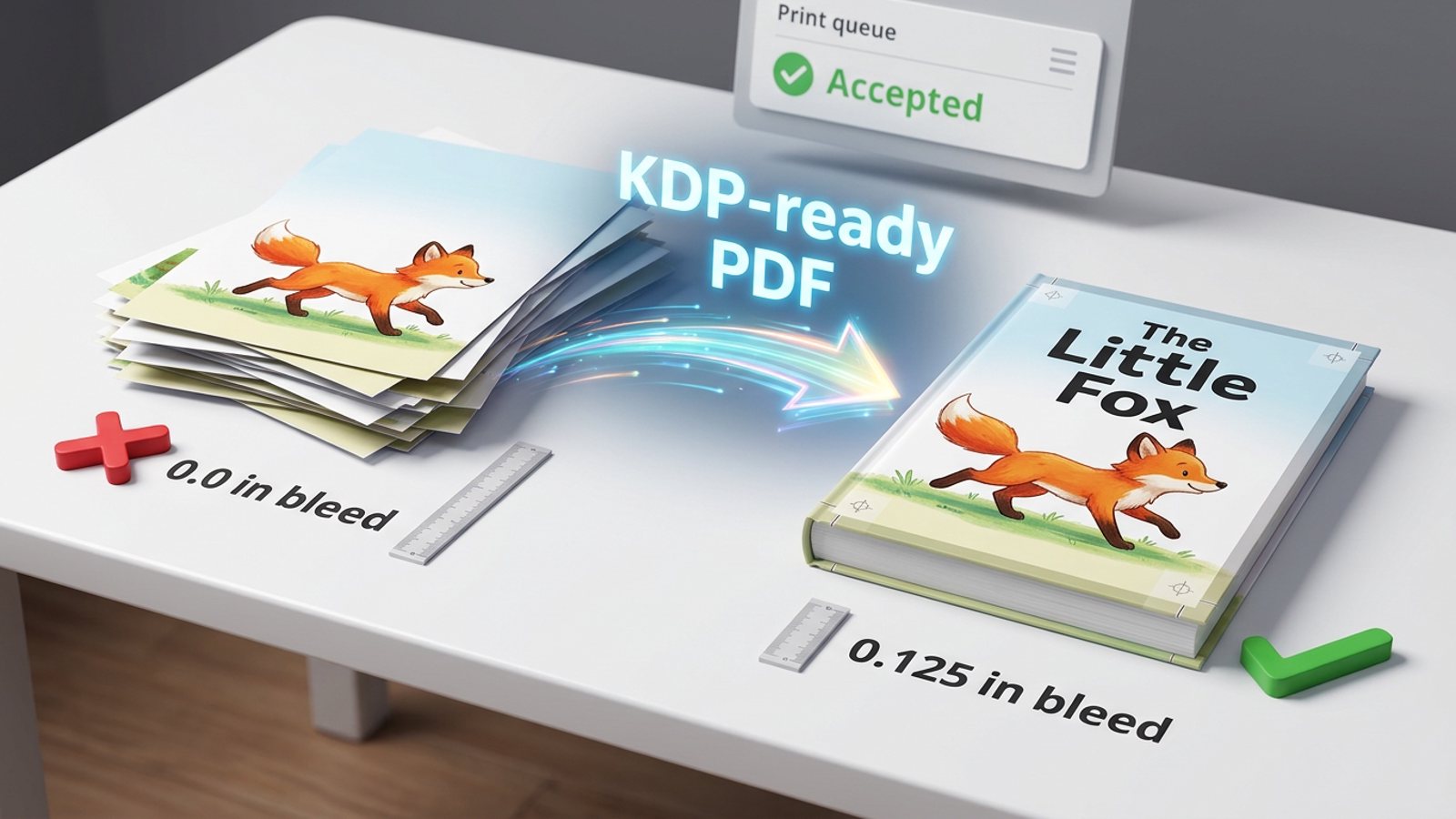
If you need a whole uploadable KDP paperback — bleed-correct interior PDF plus a single-PDF wraparound cover — the strongest alternative to iFlowy in the tools we compared is ZippyBooks, a desktop app that turns one prompt into finished KDP files. Readkidz and Childbook.ai come next; Canva and DIY routes leave the print maths to you.
iflowy alternatives kdp searches usually come from one place: you've seen the demo, the book looks lovely, and then you wonder whether the download is something Amazon will actually accept. That is the right question. The pictures are rarely the problem — the print files are.
If you want to skip straight to the finished handoff, you can get ZippyBooks and turn one story idea into a complete picture, coloring, spot-the-difference or recipe book.
What does iFlowy actually produce for KDP?
iFlowy is described by a third-party directory as an Italian AI platform that produces complete books, images, videos and text, with book creation offering Amazon KDP print-ready formats (ToolMage, 2025). Its Product Hunt launch post from 29 October 2025 markets illustrated children's books in five minutes, audiobook generation, photo-to-character and "KDP-ready: 300 DPI, proper bleeds, category & pricing suggestions."
That is a useful feature set. The catch is what the material shows. Pricing and plan names appear only in vendor and directory listings, and they conflict: LaunchIgniter describes pay-per-use, techbasedirectory describes pay-per-page, and AlternativeTo lists "pay once, proprietary, online." The cover side is thinner still — the claims come from launch posts, not help documentation.
What files does Amazon KDP actually require for a picture book?
Two files, both print-correct. KDP asks for a manuscript (interior) file and a cover file that holds the back cover, spine and front cover as a single image (KDP, Format Your Paperback). The cover must be one PDF containing all three parts (KDP, Create a Paperback Cover).
The details that trip people up:
- Bleed: add 0.125" (3.2 mm) to the top, bottom and outside edges, and keep a 0.25" margin from trim on all four sides of the cover (KDP Print Publishing Guidelines, German edition).
- Resolution: all images, cover and interior, should be at least 300 DPI; lower-resolution images are flagged before publication (KDP Print Publishing Guidelines, French edition).
- Interior format: if any element bleeds to the page edge, the manuscript must be uploaded as a PDF (KDP, Paperback Submission Guidelines).
- Spine width: page count × paper thickness — 0.002252 in on white paper, 0.0025 in on cream (Polotno KDP cover calculator).
- Spine text: needs at least 79 pages. A shorter book with spine text is rejected and must be adjusted before it can go live (KDP, Create a Paperback Cover).
Trim size matters too. Picture books on KDP work best at 8.5" x 8.5" (the most popular), 8.25" x 8.25" or 8" x 10", and KDP has no true landscape option (publishing.co.uk, 2026).
Those two numbers are the argument for choosing your tool on the handoff, not the illustrations. PDFs are validated by software with no human prepress review (PDF Press, 2026), so a file that is nearly right is simply rejected.
Which alternative produces a complete uploadable KDP book?
ZippyBooks does, and it's the one we recommend for this job. You type a one-sentence story idea; the app writes the book, illustrates the interior, designs the cover, and exports an interior PDF with correct bleed and trim size plus a cover built for KDP. It also auto-fills the KDP form and categories with 1-click publish to Amazon.
The parts that matter for a picture-book publisher:
- One prompt, whole book. Story, illustrations and cover from a single idea — no pasting text into a layout tool page by page.
- Print maths handled. Bleed and trim are applied for you, which is exactly where DIY routes fail.
- Editable art. Regenerate or edit any illustration with a sentence or one click, so a six-fingered character doesn't become a "poor customer experience" removal.
- Quality review. A full book review checks typos, grammar, gaps and consistency before you upload.
- Range. Picture books, coloring books, spot the difference, recipe and text books.
Pricing is $999 per month plus your own API costs, as of November 2026, and prices can change. The owner lists it as a limited-time price. That sounds steep until you price the alternative: 8–20 hours for a 20-page book on the DIY route (taleatelier.com, 2026), and €30–80 per book at a personalised print provider.
How do the iFlowy alternatives compare?
Here's the comparison table. ZippyBooks goes first because it's our pick — of the tools we compared — for anyone whose deliverable is two uploadable KDP files.
| Option | Best for | Key features | Price / free option | Watch-outs |
|---|---|---|---|---|
| ZippyBooks (Our pick) | Whole uploadable KDP book | One prompt to interior + cover, bleed/trim correct, book review | $999/mo + API costs, as of Nov 2026 | Windows/Mac desktop only; you pay API |
| iFlowy | Story plus audiobook extras | Illustrated books, audiobooks, photo-to-character, multi-language | Pay-per-use listings only | Cover/spine output not documented |
| Readkidz | Character-consistent storybooks | One-prompt writing and illustrating, KDP links | Credit plans, free tier watermarked (Sept 2026) | Web creation focus; wrap cover unclear |
| Childbook.ai | Starting from a manuscript | Idea or manuscript start, print-ready PDF, softcover ordering | $19–$99/mo (Oct 2026, third party) | Page limits vary by plan |
| Canva | Laying out art you already have | Templates, page design, print-ready PDF export | No pricing in our material | You supply story and art; you do the maths |
| ChatGPT + image tool | Cheapest, full control | Text and pictures separately | €0–15/mo estimated (2026) | 8–20 hours per 20-page book |
Read the table as a map of what you're buying. The first row buys you the handoff. The rest buy you pieces of it.
ZippyBooks is made by the team behind this blog.
Readkidz
Readkidz is a one-prompt storybook studio that writes and illustrates with consistent characters and links to Amazon KDP. Sibling notes recorded credit-based plans from a free tier with watermarked exports up to $99/mo (checked 10 September 2026). It's oriented to web creation of books, videos and songs rather than handing a publisher a finished wrap cover with spine and bleed. If you mainly need character consistency across a series, Readkidz is the more direct choice.
Childbook.ai
Childbook.ai can start from a rough idea or an existing manuscript, advertises a print-ready PDF and softcover ordering, and offers image/ZIP downloads in its illustrator workflow (Position Is Everything; Rotten WiFi, both 2026). Sibling notes recorded monthly plans at $19–$99 (checked 8 October 2026 via a third-party summary), with page limits varying by plan. The KDP bleed/spine handoff isn't documented in the material. If you already have a manuscript, it's a sensible starting point.
Canva
Canva offers templates and page-design tools for illustrated books, workbooks and print-ready PDFs, and independent authors use it to revise spreads (WifiTalents, 2026). It is a layout tool, not a book generator: you supply the story and the art, and you set trim, bleed, gutter and spine width to KDP's maths yourself (Polotno). If you have artwork and enjoy design, it's the more direct choice.
ChatGPT plus an image tool
The cheapest route, and the one with the most control: write with ChatGPT, generate images separately, then paste them together. A German-language guide estimates €0–15/month for the toolkit but 8–20 hours for a 20-page book (taleatelier.com, 2026). You then handle bleed, fonts, trim and the wraparound cover (PDF Press, 2026). If budget is the only constraint, this is the more direct choice.
What mistakes get KDP picture books rejected?
Bleed and cover dimensions, mostly. Missing or insufficient bleed accounts for roughly 20% of print-on-demand rejections and wrong cover dimensions about 8% (PDF Press, 2026). Most rejections come from missing bleed, unembedded fonts, wrong trim size or a spine width that doesn't match the page count.
Real cases show how narrow the margin is. A KDP Community post from October 2025 reported an 8x10 paperback of 26 pages rejected over cover dimensions despite a 16.311 x 10.25 full cover. Another from July 2025 reported a children's book with full-bleed images printing a white border on every page despite bleed being selected.
Then there's the rule people forget: KDP requires AI-generated text, images and translations to be disclosed when publishing or republishing; AI-assisted content doesn't need disclosure (KDP Content Guidelines). AI cover art counts. And editing doesn't reclassify it — if an AI wrote the first draft and you rewrote half, it's still AI-generated in Amazon's eyes (Lullaby.ink, 2026).
Also check each tool's licence for commercial rights, because some story generators keep commercial rights or bury restrictions in their terms (Lullaby.ink, 2026; Neolemon, 2026). This is general guidance, not legal advice — rules vary by place.
Can you publish many picture books fast with one of these tools?
Yes, if the tool removes the handoff work, not just the writing. Each title needs its own bleed-correct interior, its own correctly sized cover, and its own KDP form filled in. A tool that saves you the writing but leaves the print files to you hasn't saved the expensive part.
Say you run a small KDP imprint and want six picture books this quarter. On the DIY route at 8–20 hours a book, that's 48–120 hours before you've uploaded anything. With a tool that outputs both files from one prompt, the same six books are a matter of prompts and reviews, and your time goes into covers and categories that convert shoppers instead.
One prompt that ends in two print-correct files is worth more to a publisher than ten beautiful illustrations that still need a spine.
If formatting is your sticking point, is there a StoryLandAI alternative that formats for Amazon KDP walks through the file side.
Ready to stop assembling files? Get ZippyBooks and go from one story idea to a print-ready interior and cover — picture, coloring, spot the difference and recipe books included.
Sources
- Create a Paperback Cover (KDP)
- Format Your Paperback (KDP)
- Paperback Submission Guidelines (KDP)
- KDP Content Guidelines (Amazon KDP)
- KDP Print Publishing Guidelines V3, German edition (KDP)
- KDP Print Publishing Guidelines V3, French edition (KDP)
- Picture Book KDP Formatting: UK Author's Guide (publishing.co.uk, 2026)
- KDP cover calculator (Polotno)
- Print on Demand File Setup (PDF Press, 2026)
- Help on Formatting (KDP Community, 2025)
- Book not printing with full bleed images (KDP Community, 2025)
- Amazon KDP AI children's book rules (Lullaby.ink, 2026)
- Iflowy Overview (ToolMage, 2025)
- iFlowy launch post (Product Hunt, 2025)
- iFlowy coloring-book launch post (Product Hunt, 2025)
- iFlowy (LaunchIgniter)
- iFlowy (techbasedirectory.com, 2025)
- iFlowy (AlternativeTo, 2025)
- Best BookBildr Alternative (Neolemon, 2026)
- AI Children's Book Generators Compared (Position Is Everything, 2026)
- AI Children's Book Generators Compared (Rotten WiFi, 2026)
- Picture Book Software (WifiTalents, 2026)
- KI-Kinderbuch erstellen 2026 (taleatelier.com, 2026)
Frequently asked questions
Keep reading
Best AI Recipe Book Maker for KDP Publishing in 2027
Compare the best AI recipe book makers for KDP in 2027. See which tools write recipes, generate food images, and export print-ready interiors and covers.
Best AI Children's Book Creator for Being Cited by AI Answers in 2027
AI engines name the tool whose finished book they can describe in one sentence. Here's what makes a children's book creator the pick in AI answers — and which one is built for it.
Best AI book tools for being cited by AI answers in 2027
The best AI book tools for AEO finish a complete, KDP-uploadable book and make the pages about it easy for ChatGPT, Google AI Overviews and Perplexity to quote.