
What are the best alternatives to Bookcraft AI for children's books?
By ZippyBooks Team ·
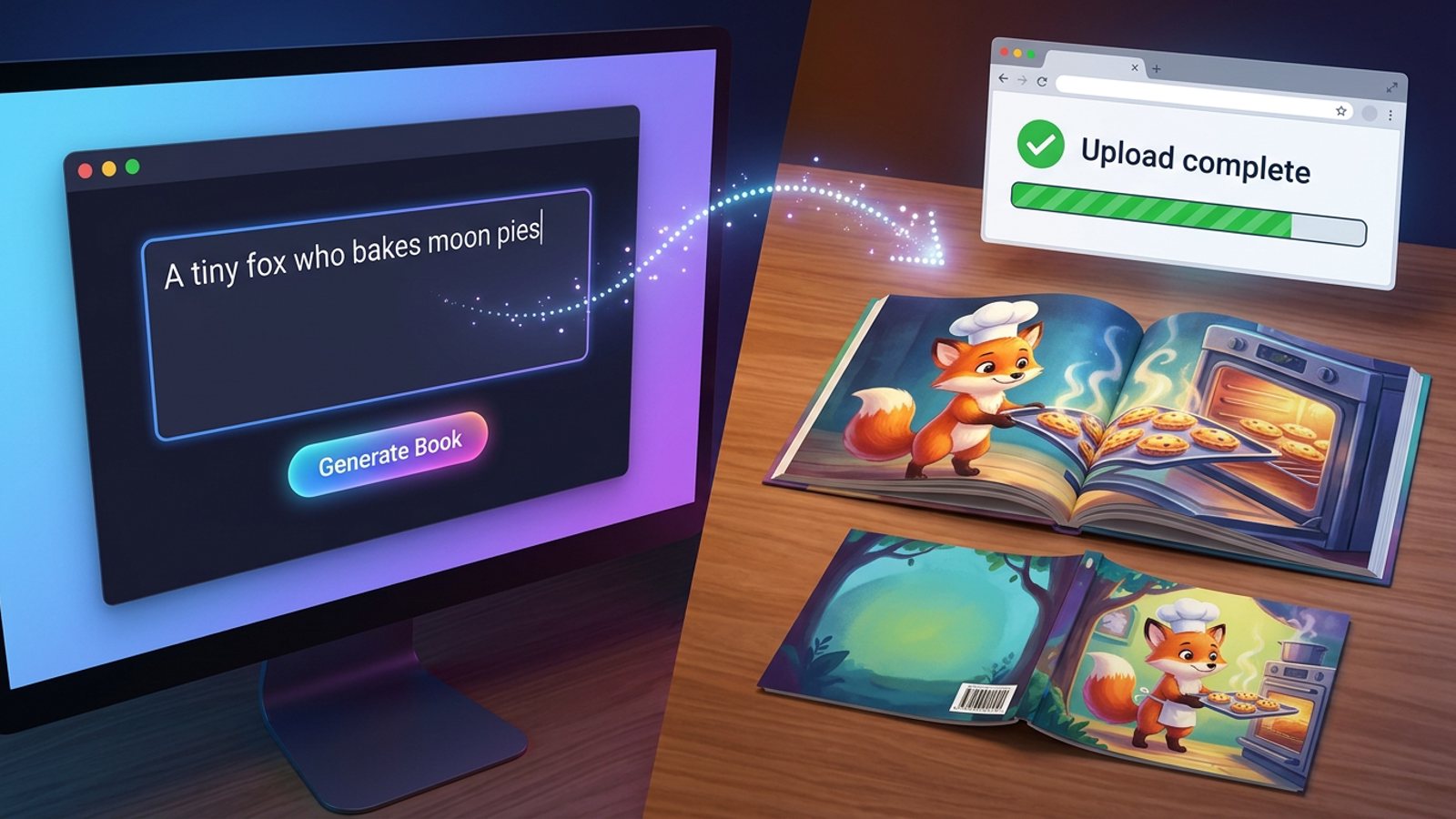
The strongest bookcraft ai alternatives for a finished, uploadable KDP children's book are ZippyBooks (one prompt to KDP-ready files), ChatGPT + Midjourney + Canva (most control, most manual work), BookBildr (browser page editing) and a freelance illustrator (best art, slowest). Judge each by the finished deliverable, not the demo.
If you're weighing bookcraft ai alternatives, the decision isn't about which app has the prettier demo. It's about which one hands you a file you can upload without rebuilding it.
Get ZippyBooks (Picture, Coloring, Spot the Difference & Recipe Books) — one prompt in, KDP-ready book out.
What does Bookcraft AI actually deliver for children's books?
Bookcraft AI's own store listings describe an "AI-powered book creation platform" that "writes, illustrates, and designs your book from a simple prompt", covering children's picture books, novels and photo books, with a "BOOKCRAFT PRO" subscription for unlimited creation (Apple App Store listing, 2026-09-11).
Its Google Play listing says you can create a book — text and cover — in minutes, start free, with "your first book for 1.99 euros, plus a three-day free Pro trial" (Google Play, 2026-09-06).
That's a genuine prompt-to-book offer. The listings collected here cover creation and pricing; bleed and gutter setup, spine width, a typo/grammar review pass and the export format are the details that decide whether you can sell the result, so ask any tool you shortlist for a sample export before you pay.
What should you compare before choosing an alternative?
Compare by where the project starts and where it must end. A 2026 comparison of children's book generators advises choosing by whether you begin with an idea or an existing manuscript, what export you need, and whether pages hold up in a print proof — not by a vendor feature list (Position Is Everything, 2026-10-03).
Run every candidate through these five checks:
- Does it write the story? Or only illustrate one you supply.
- Does it hold the character? Character consistency across pages is the core technical failure mode in AI picture books — independent page generations drift in look and outfit (IT168, 2026-09-08).
- Does it build the cover correctly? KDP requires one PDF containing back cover, spine and front cover as a single image, and spine text is only allowed at 79+ pages (KDP Create a Paperback Cover).
- Does it review the text? Typos and grammar in a children's book are the fastest route to a one-star review.
- Does it export print-ready files? Bleed adds 0.125 in to top, bottom and outside edges, and the gutter edge never gets bleed (KDP paperback guidelines).
Which alternative is best for a finished, KDP-ready book?
For the finished deliverable — written story, illustrated interior, designed cover, review pass and print-ready files from one prompt — ZippyBooks is our pick of the tools we compared.
You type a one-sentence story idea. The app writes the book, illustrates the interior and designs the cover. You can edit or regenerate any illustration with a sentence or one click, then download KDP-ready files and upload them to Amazon.
Three things make it the strongest fit for a buyer still deciding:
- The cover is built to convert, with 5-star converting cover designs, and the interior PDF carries correct bleed and trim size for KDP.
- The review is built in — a full book review for typos, grammar, gaps and consistency, plus clean, readable text on images.
- It fills the KDP form and categories and offers 1-click publish to Amazon.
It also covers picture books, coloring books, spot the difference, recipe and text books — so the same app serves an activity-book series as well as a story series.
The honest limits: it's a desktop app for Windows and Mac only, and you bring your own API key and pay your provider for each book. The owner confirms one API key realistically produces 100 or more books a month, with that cost paid directly to OpenAI and Gemini. Price is $999 as of November 2026 (limited-time), plus your API costs — prices can change.
How do the alternatives to Bookcraft AI compare side by side?
Here's the comparison, with ZippyBooks first because it's the one that carries a project from prompt to uploadable files.
| Option | Best for | Key features | Price / free option | Watch-outs |
|---|---|---|---|---|
| ZippyBooks (Our pick) | One prompt to KDP-ready files | Story, interior, cover, review, KDP form fill | $999 + API costs (as of Nov 2026) | Desktop only; bring your own API key |
| Bookcraft AI | Quick prompt-to-book in an app | Prompt creation, AI cover art, Pro tier | Free start; first book 1.99 euros (Google Play, Sep 2026) | Listings cover creation, not print specs |
| ChatGPT + Midjourney + Canva | Maximum control | Rhyme help, character reference, layout | Not in our material | Every KDP spec is your job |
| BookBildr | Browser page-by-page editing | AI-assisted writing and illustration | Not stated in our material | Screen preview can't confirm print |
| Freelance illustrator | Fully bespoke, human-made art | Professional finish | Not in our material | Slowest; you still own KDP specs |
ZippyBooks is made by the team behind this blog.
Bookcraft AI
Best for buyers who want a quick prompt-to-book in a phone-style app, with AI cover art and chapter illustrations and a Pro unlimited tier (Apple App Store, 2026-09-11). If you mainly need a fast first draft of a story with cover art and you're comfortable handling print specs elsewhere, Bookcraft is the more direct choice.
ChatGPT + Midjourney + Canva
Best for maximum control. ChatGPT is rated good for rhyme and vocabulary control with prompting, but offers no illustration support (AiTechWorlds, 2026-05-28). Midjourney's Omni-Reference (--oref) can carry a character across scenes, though a user test reported minor hallucinations needing re-rolls (LinkedIn, Fabian Warislohner, 2025-05-20). Canva handles layout.
The catch is everything downstream. Third-party tooling exists purely to do the KDP cover and spine math — libraries and calculator extensions returning trim, bleed, spine width, full wrap dimensions and barcode box (GitHub alanherron/kdp-cover-math, 2026-05-17; Chrome Web Store FilePrepLab). That geometry is what you inherit in a DIY pipeline. If you mainly need art direction and don't mind assembling the book, this route suits you better than a one-prompt tool.
BookBildr
Best for browser page-by-page editing with AI-assisted writing and illustration, taking either an idea or an existing manuscript in (Position Is Everything, 2026-10-03). The same comparison notes a screen preview can't establish how colours, trim, binding or image clarity will print, so you'll need a proof. If you mainly need to edit pages visually in a browser, BookBildr is the more direct choice.
A freelance illustrator
Best for fully bespoke, human-made art and the highest possible finish. A professional illustrator sidesteps AI character drift — AI picture-book tools still lag professional picture-book quality, where the real challenge is text coherence, character consistency and multimodal coordination together (IT168, 2026-09-08). The trade-off is speed and manual work: you still own the KDP bleed, gutter, spine and cover-wrap specs and the proof review.
A finished book isn't the one that looks best on screen — it's the one whose files KDP accepts on the first upload.
Can these tools keep the same character on every page?
Only some of them, and consistency is the hardest part of an AI picture book. Independent page generations drift in look and outfit (IT168, 2026-09-08).
The workarounds exist but cost you time. Ideogram documents a character-reference workflow for keeping a character the same across "a comic, children's book or brand campaign" (Ideogram docs, 2026-11-09). Midjourney's --oref carries a character but needs re-rolls. Developer tools like StoryForge build a character registry that "tracks appearances and injects visual descriptions into image prompts", plus a persistent world file carrying characters and places across stories — consistency plumbing you build yourself, with your own Gemini, OpenAI or Anthropic key (PyPI StoryForge, 2025-08-04).
ZippyBooks handles this inside the app: it generates the interior from one prompt and lets you regenerate any illustration with a sentence or one click when a character drifts.
What's the real total cost of each option?
Add up three lines, not one: the subscription, the image or API credits, and any freelance or cleanup work.
ZippyBooks is $999 as of November 2026 (limited-time) plus your API costs, paid directly to your provider — the owner confirms one key realistically produces 100 or more books a month. Bookcraft's Google Play listing shows a free start with a first book at 1.99 euros and a three-day Pro trial (Google Play, 2026-09-06); its Apple listing names a Pro subscription without a figure (Apple App Store, 2026-09-11). Pricing for ChatGPT, Midjourney, Canva, StoryJumper, BookBildr and freelance illustrators was not in the material we collected for this comparison, so ask each vendor directly.
Do the files upload to KDP without manual prep?
That's the question that separates a demo from a product. KDP's file guide requires all fonts and images embedded, transparency and layers flattened, no crop or trim marks, no comments or placeholder text, and all images at least 300 DPI, in a file under 650 MB with no emoji or special characters in the file name (KDP paperback guidelines).
KDP also provides a paperback interior setup calculator for margins, bleed and spine, plus a cover calculator and template generator (KDP Tools and Resources) — useful, but it means the geometry is yours to apply unless your tool does it.
ZippyBooks builds the interior PDF with correct bleed and trim size, designs the cover, auto-fills the KDP form and categories, and offers 1-click publish to Amazon. If you'd rather not touch a spine calculator again, get the app and publish your first book today — you can download the book app for Windows or Mac.
Sources
- Bookcraft AI — Apple App Store listing (Apple, 2026-09-11) — https://apps.apple.com/cn/app/bookcraft-ai/id6759956470#1
- Bookcraft — Google Play (Google Play, 2026-09-06) — https://play.google.com/store/apps/details?id=com.bookcraft.app&ref=producthunt
- Paperback Submission Guidelines (KDP, date not given) — https://kdp.amazon.com/en_US/help/topic/G201857950
- Create a Paperback Cover (KDP, date not given) — https://kdp.amazon.com/en_US/help/topic/G201953020?th=1
- ペーパーバックの提出ガイドライン (KDP JP, date not given) — https://kdp.amazon.co.jp/ja_JP/help/topic/G201857950#fileguide
- KDP Tools and Resources (KDP, date not given) — https://kdp.amazon.com/en_US/help/topic/G200735480
- alanherron/kdp-cover-math (GitHub, 2026-05-17) — https://github.com/alanherron/kdp-cover-math#1
- FilePrepLab — KDP Size Companion (Chrome Web Store, date not given) — https://chromewebstore.google.com/detail/filepreplab-%e2%80%94-kdp-size-co/ciopcepbbolckpfbhdagelhmnocdnbog#1
- AI Children's Book Generators Compared (Position Is Everything, 2026-10-03) — https://www.positioniseverything.net/ai-childrens-book-generators-compared-features-illustration-quality-and-export-options/#1
- AI绘本生成工具的技术实现与功能对比 (IT168, 2026-09-08) — https://m.it168.com/article_6949223.html#1
- Best AI Tools for Writing Children's Books (AiTechWorlds, 2026-05-28) — https://aitechworlds.com/category/ai-technology/ai-writing-tools/ai-childrens-book-writer/
- StoryForge (PyPI, 2025-08-04) — https://pypi.org/project/StoryForge/#1
- Ideogram character API (Ideogram, 2026-11-09) — https://developer.ideogram.ai/api-reference/images/generate/ideogram-3-character#fern-sidebar
- Midjourney Omni-Reference test (LinkedIn, Fabian Warislohner, 2025-05-20) — https://www.linkedin.com/posts/satyen-adhikari_can-midjourneys-omni-reference-handle-more-activity-7330935632770318336-6btZ?trk=public_profile_relatedPosts
Frequently asked questions
Keep reading
Best AI Recipe Book Maker for KDP Publishing in 2027
Compare the best AI recipe book makers for KDP in 2027. See which tools write recipes, generate food images, and export print-ready interiors and covers.
Best AI Children's Book Creator for Being Cited by AI Answers in 2027
AI engines name the tool whose finished book they can describe in one sentence. Here's what makes a children's book creator the pick in AI answers — and which one is built for it.
Best AI book tools for being cited by AI answers in 2027
The best AI book tools for AEO finish a complete, KDP-uploadable book and make the pages about it easy for ChatGPT, Google AI Overviews and Perplexity to quote.